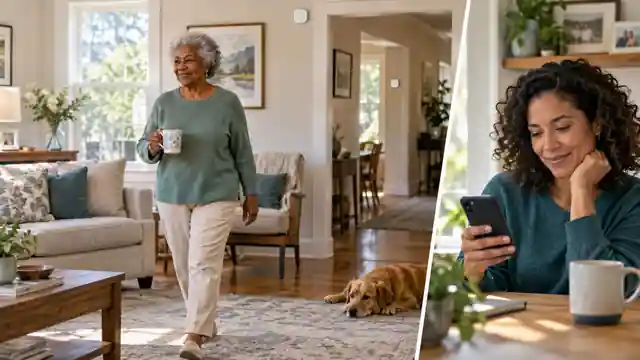
If you are trying to monitor an elderly parent remotely without cameras, the goal usually is not to watch every moment. It is to know when something important changes: a parent does not get out of bed at the usual time, stays in the bathroom much longer than expected, leaves home at an unusual hour, or stops following a familiar routine.
Camera-free monitoring can fill some of that gap. The main options include scheduled check-ins, medical alert devices, ordinary smart-home sensors, and passive monitoring systems that turn activity data into caregiver alerts. This guide explains how those options differ and takes a closer look at envoyatHome, a passive monitoring service designed for families supporting older adults who live independently.
Quick answer
Yes, an older parent can be monitored remotely without indoor cameras. Passive systems can use motion, door, and cabinet sensors to show whether expected activity is happening without recording video or audio. envoyatHome is one example: the company says its system uses small sensors and an internet-connected hub to send caregiver alerts and behavior reports without cameras, microphones, GPS tracking, wearables, or buttons. It is a caregiving-awareness tool, not a medical device or a replacement for emergency services, hands-on care, or clinical monitoring.
Why families look for senior monitoring without cameras
For many families, the problem is the time between visits and phone calls. A parent may still be independent enough to live alone, while an adult child is left wondering whether the day is unfolding normally.
Indoor cameras provide visual confirmation, but they also create a significant privacy tradeoff. Bedrooms, bathrooms, living areas, and ordinary daily routines are personal. Passive monitoring takes a different approach: it looks for activity or changes in routine without creating a video feed.
That can be useful when the real question is not “Can I see Mom right now?” but “Has something changed enough that I should check in?”
The National Institute on Aging notes that aging in place requires planning around safety, daily activities, transportation, health needs, and available support. Technology can add information, but it does not replace the people and services an older adult may need to remain safely at home.
How can you monitor an elderly parent remotely?
There is no single device that solves every caregiving problem. The useful approach is to match the tool to what you actually need to know.
| Option | What it tells you | Main limitation |
|---|---|---|
| Calls and texts | How the person sounds and what they choose to share | Depends on answering, remembering, and self-reporting |
| Medical alert system | A request for help or, on some models, an automatically detected event | May depend on wearing, charging, reaching, or activating a device |
| Indoor cameras | Direct visual information in the camera’s field of view | Greater privacy and surveillance concerns |
| DIY smart-home sensors | Individual events such as a door opening or motion in a room | Family must interpret separate device alerts and build the response plan |
| Passive monitoring service | Patterns, missed routines, unusual activity, or prolonged inactivity | Does not explain why a behavior changed and cannot provide hands-on help |
What is passive monitoring for seniors?
Passive monitoring uses sensors in the home rather than asking the older adult to actively operate a device. Depending on the system, sensors may detect movement, doors opening, cabinet activity, or other routine events. Software can then look for activity that is expected, delayed, missing, or unusual.
The appeal is straightforward: the person can go about the day without remembering to wear, charge, or press anything.
That does not mean passive monitoring can determine a diagnosis or guarantee safety. A change in activity is only a signal. Less movement could mean someone is resting, has gone out with family, is not feeling well, or simply changed plans. The value comes from giving caregivers a reason to check in when the pattern is different.
Research into passive remote monitoring is still developing. A published scoping review found that these technologies are being used in a variety of ways to support aging in place, while also concluding that stronger research is still needed to establish how effectively they extend independence. That is an important distinction: passive monitoring can provide useful information without proving that it will prevent every emergency or keep someone living independently longer.
How envoyatHome works
envoyatHome is a consumer subscription service for family caregivers. According to the company’s current FAQ, the system uses motion sensors, door and cabinet sensors, and an internet-connected hub. The sensors are battery powered and are intended to work in the background without requiring the older adult to interact with them.
Instead of showing the caregiver raw motion events, envoyatHome says its software translates sensor activity into recognizable behavior and sends alerts when a caregiver-selected situation is considered important. It also provides Insight reports intended to show changes over time.

What can envoyatHome monitor?
envoyatHome says it monitors more than 35 behaviors or situations across areas such as safety, wellness, cognitive wellness, and adherence to selected routines. Its public examples include prolonged immobility, unexpected departures, nighttime activity, missed routines, unusual bathroom patterns, and changes in movement over time.
For fall-related situations, it is useful to understand the mechanism. envoyatHome describes its approach as identifying the unexpected immobility that may follow a fall, rather than depending only on an impact sensor worn on the body. That is different from saying a sensor can visually confirm exactly what happened.
Falls are a legitimate concern for older adults: the CDC reports that more than one in four adults age 65 and older falls each year. But no monitoring product should be treated as a substitute for fall-prevention measures, medical evaluation, or an emergency response plan.
Does envoyatHome use cameras or microphones?
No. envoyatHome states that it uses no cameras, microphones, listening devices, GPS tracking, or wearables. Its FAQ says the in-home sensors detect activity rather than recording images or audio.
That privacy model is one of the clearest reasons a family might consider passive monitoring instead of indoor cameras.
What does envoyatHome cost in 2026?
As checked on September 18, 2026, envoyatHome lists standard pricing at $99 per month plus a one-time $399 equipment fee. The company says its standard equipment package includes eight sensors and one internet hub and supports most care plans. Taxes and shipping are additional.
The subscription currently includes 24/7 behavior monitoring, real-time alerts, daily and weekly Insight reports, virtual setup help, phone and email support, and the ability to add multiple family caregivers without an additional caregiver fee. envoyatHome says there is no long-term contract and families may cancel at any time.
Check current envoyatHome pricing and details →
Important limitations to understand before buying
envoyatHome is not a medical device. The company explicitly states that it does not diagnose medical conditions. Activity information can prompt a caregiver to check in or give a clinician additional context, but it does not tell you the medical reason for a change.
It is not the same as a personal emergency response service. envoyatHome describes itself as a passive monitoring service that alerts the caregiver team. Families still need a plan for who will respond, who has access to the home, and when emergency services should be contacted.
Internet and power matter. envoyatHome says monitoring is unavailable during a power or internet outage. The app notifies caregivers of the outage, and the system restarts automatically when service returns.
Pets and home layout can affect setup. The company says pets are usually not a problem, although large or highly active pets may affect some monitoring features. Larger or unusually configured homes may require additional sensors or an internet range extender.
Monitoring does not provide hands-on care. It cannot prepare meals, give medications, assist with bathing, provide transportation, or physically help someone who is on the floor. If those are the needs driving the concern, the family may need in-home services rather than — or in addition to — monitoring technology.
Passive monitoring vs. a medical alert system
These products solve different problems.
A traditional medical alert system is primarily designed to help someone request assistance during an emergency. Some systems include automatic fall-detection features or a professional monitoring center.
A passive monitoring service is designed to give caregivers awareness of activity and routine even when the older adult does not actively request help. It may flag that expected movement has not happened or that a routine appears different.
A family can reasonably use both. A button or monitored alert service can provide a direct emergency pathway, while passive monitoring can help reveal changes that occur between calls and visits. The right combination depends on the person’s abilities, preferences, risk factors, and available responders.
What if your parent is on dialysis?
For an older adult receiving in-center hemodialysis, a passive home system may be relevant to the caregiving side of the day rather than the dialysis treatment itself. A family might care whether the person returned home, resumed a normal routine, was unusually inactive, or stayed in one area much longer than expected.
It is important not to confuse that with medical monitoring. envoyatHome does not monitor dialysis treatment adequacy, blood pressure, fluid removal, target weight, vascular access, laboratory values, or the cause of post-treatment symptoms. envoyatHome also states that it does not collect health data.
If activity is different after dialysis, that observation may be worth noting and discussing, but the dialysis care team is the appropriate source for questions about symptoms, treatment, or changes in health. Renal Care Planner’s My Treatment tool and Caregiver Hub can help keep those observations and follow-up questions organized.
Questions to ask before choosing any elderly monitoring system
- What problem are we solving? Emergency access, wandering, missed routines, overnight activity, or general reassurance?
- What does the older adult consent to? Cameras, passive sensors, wearables, or only scheduled check-ins?
- Who receives alerts, and who is available to respond?
- What happens during a power, internet, or cellular outage?
- Does the system require the person to wear, charge, remember, or activate anything?
- Does the company provide professional emergency monitoring, or are alerts sent only to family?
- What information is collected, stored, and shared?
- What are the total monthly, equipment, shipping, and cancellation costs?
Frequently asked questions
Can I monitor an elderly parent remotely without cameras?
Yes. Options include scheduled calls, medical alert devices, door and motion sensors, smart-home devices, and passive monitoring services. Camera-free systems can provide information about activity without recording video.
What is the best way to monitor an elderly parent who lives alone?
There is no single best setup for every family. Start with the problem you need to solve and the older adult’s preferences. Someone who needs a direct emergency connection may need a different system than someone whose family mainly wants awareness of routines and unusual inactivity.
Does envoyatHome require the senior to wear anything?
No. According to envoyatHome, its standard system uses sensors in the home and does not require a wearable, pendant, button, camera, or microphone.
How much does envoyatHome cost?
As of September 18, 2026, envoyatHome lists its standard service at $99 per month plus a one-time $399 equipment fee. Taxes and shipping are additional, and pricing can change.
What happens if the internet goes out?
envoyatHome says monitoring is unavailable during a power or internet outage. Caregivers receive an outage notification, and monitoring restarts automatically when service returns.
Can passive monitoring diagnose dementia, a UTI, a fall, or another medical problem?
No. Activity changes can be a reason to check in, but they do not establish a diagnosis. envoyatHome states that it is not a medical device and does not diagnose conditions.
Bottom line
If your main concern is how to monitor an elderly parent remotely without cameras, passive sensors are a legitimate category to compare with medical alert devices, scheduled check-ins, and other aging-in-place supports.
envoyatHome is notable because it combines camera-free sensors with software that attempts to turn household activity into caregiver-friendly alerts and reports. Its strongest fit is likely a family that wants more awareness of an older adult’s routine without requiring that person to wear or operate another device.
The important limitation is just as clear: it provides information, not hands-on care, emergency dispatch, or medical diagnosis. The value depends on whether your family has a practical response plan for the alerts it provides.
Read our detailed envoyatHome review →
How this guide was prepared
Renal Care Planner reviewed envoyatHome’s current public FAQ, pricing, product information, and technical descriptions and compared those claims with independent information on aging in place, falls, and passive remote monitoring. We have not independently tested envoyatHome in a private home. Product capabilities and pricing can change, so verify current details before purchasing.
Start With the Person, Not the Technology
Remote monitoring works best when the older adult understands what is being used and is comfortable with it. If cameras feel too intrusive, other options can provide limited information about routines or check-ins without creating a live view inside the home. The right level of monitoring depends on the person’s needs, preferences, and safety situation.
Related caregiver resources
Dialysis Caregiver Guide & Support · Caregiver guide for someone new to dialysis · When a rough day becomes a pattern · Care team and contacts worksheet · My Treatment
Sources: envoyatHome FAQ; envoyatHome pricing; National Institute on Aging: Aging in Place; CDC: Facts About Older Adult Falls; and Canadian Journal on Aging: Passive Remote Monitoring and Aging in Place.
For general education only. Monitoring technology does not replace emergency services, medical care, direct caregiving, or professional judgment.