

Dialysis takes about twelve hours a week in the chair, and the rest of the week can feel shorter than it used to. Cooking, cleaning, bathing after a draining treatment, getting groceries, and keeping up with medications can start to pile up. In California, a Medi-Cal program called In-Home Supportive Services, or IHSS, may pay someone to help with those everyday tasks at home. That someone can be a family member or a friend you already trust.
Quick answer
IHSS is a California program for people who are aged, blind, or disabled, have Medi-Cal eligibility, and need help to stay safely at home. Being on dialysis does not automatically qualify you. What counts is which daily tasks you cannot safely do on your own. If you are approved, the county authorizes a set number of hours per month, and you choose and supervise the person who provides the help. You apply through your county IHSS office using form SOC 295, and a licensed health care professional must complete a Health Care Certification (SOC 873) before services can be authorized.
What is IHSS?
In-Home Supportive Services is run by the California Department of Social Services and managed by each county. Its purpose is to help eligible people stay safely in their own homes instead of moving into out-of-home care. IHSS is a Medi-Cal program, so it is funded through federal, state, and county dollars.
IHSS does not pay for your dialysis treatment, and it is not a nursing service. It pays a caregiver, called a provider, for approved hours of help with everyday tasks in your home.
Who qualifies for IHSS?
According to the California Department of Social Services, every applicant must:
- Be a California resident
- Have a Medi-Cal eligibility determination
- Live at home or in a home of their own choosing (hospitals, nursing facilities, and licensed care facilities do not count)
- Submit a completed Health Care Certification form (SOC 873)
The program serves people who are 65 or older, blind, or disabled. Many people on long-term dialysis meet the disability part, but approval still depends on the county’s assessment of what you can and cannot do safely on your own. Two people on the same dialysis schedule can be authorized very different hours.
If you are not sure about your Medi-Cal status, that is the first thing to sort out. Your dialysis social worker can usually help you figure out where you stand.
What IHSS can help with
IHSS services fall into a handful of categories. The county decides which ones you need and how much time each one gets.
- Personal care: help with bathing, dressing, grooming, eating, toileting, and moving around the house.
- Household tasks: housecleaning, meal preparation and cleanup, laundry, and grocery shopping and errands.
- Paramedical services: certain health-related tasks, such as help with injections or wound care, done under the direction of a licensed health care professional.
- Accompaniment to medical appointments: help getting to and from appointments, under specific conditions (explained below).
- Protective supervision: for people with certain mental impairments who need watching to stay safe. Most dialysis patients will not need this category.
IHSS will only pay for services the county has authorized. It is meant to fill the gap between what you can do safely and what you cannot, not to replace things you can still do yourself.
How IHSS fits around dialysis days
Dialysis changes what a “normal” day looks like. The assessment should reflect your real week, not your best day. When you talk to the county social worker, think about:
- Post-treatment days: If you come home too tired, dizzy, or weak to cook, shower safely, or clean up, say so plainly.
- Meals: A dialysis diet often means more cooking from scratch and less convenience food. Meal preparation may take more time than it would for someone without dietary limits.
- Access arm limits: If your care team has told you not to lift heavy things with your fistula or graft arm, mention how that affects laundry, groceries, and housework.
- Bathing with a catheter: If you have a dialysis catheter that must stay dry, bathing may take extra time or help.
What about rides to dialysis? This is where many families get confused. California’s guidance says IHSS medical accompaniment is not authorized just because someone needs a ride. It can be authorized when you need help with another IHSS task on the way to or at the appointment, or when you cannot make the trip on your own because of your condition and the provider’s presence is what makes the trip possible. Waiting time during treatment is only paid in limited situations. We break this down in detail in a separate guide on medical accompaniment and wait time.
If you just need transportation, Medi-Cal transportation benefits and community programs may be a better fit. See Dialysis Transportation in California and What to Do If Your Ride to Dialysis Falls Through.
Who can be your IHSS caregiver?
If you are approved, you hire your own provider. The state treats you, the recipient, as the provider’s employer. That means you are responsible for choosing, training, supervising, and if needed, replacing them.
Many recipients choose an adult child, sibling, grandchild, other relative, or a trusted friend. If you do not have anyone, your county IHSS Public Authority keeps a registry of providers you can interview.
A few things to know before choosing:
- Your chosen person cannot be paid until they finish the provider enrollment steps, which include a background check, an orientation, and a signed provider agreement.
- You can never authorize your provider to work more than your total approved monthly hours.
- Pay rates are set county by county, so ask your county for the current rate.
- Spouses have special rules. A spouse is generally expected to do some tasks without pay, but may be paid for certain services in some situations. Ask your county social worker how this applies to your household.
If this sounds familiar
Maybe your daughter has been cooking your meals, doing your laundry, and driving you three times a week for months, and she is starting to cut hours at her own job to keep up. Or you have been skipping showers after treatment because you are worried about falling. These are exactly the situations IHSS is designed to look at. You do not need to be in a crisis before you apply.
How to apply for IHSS, step by step
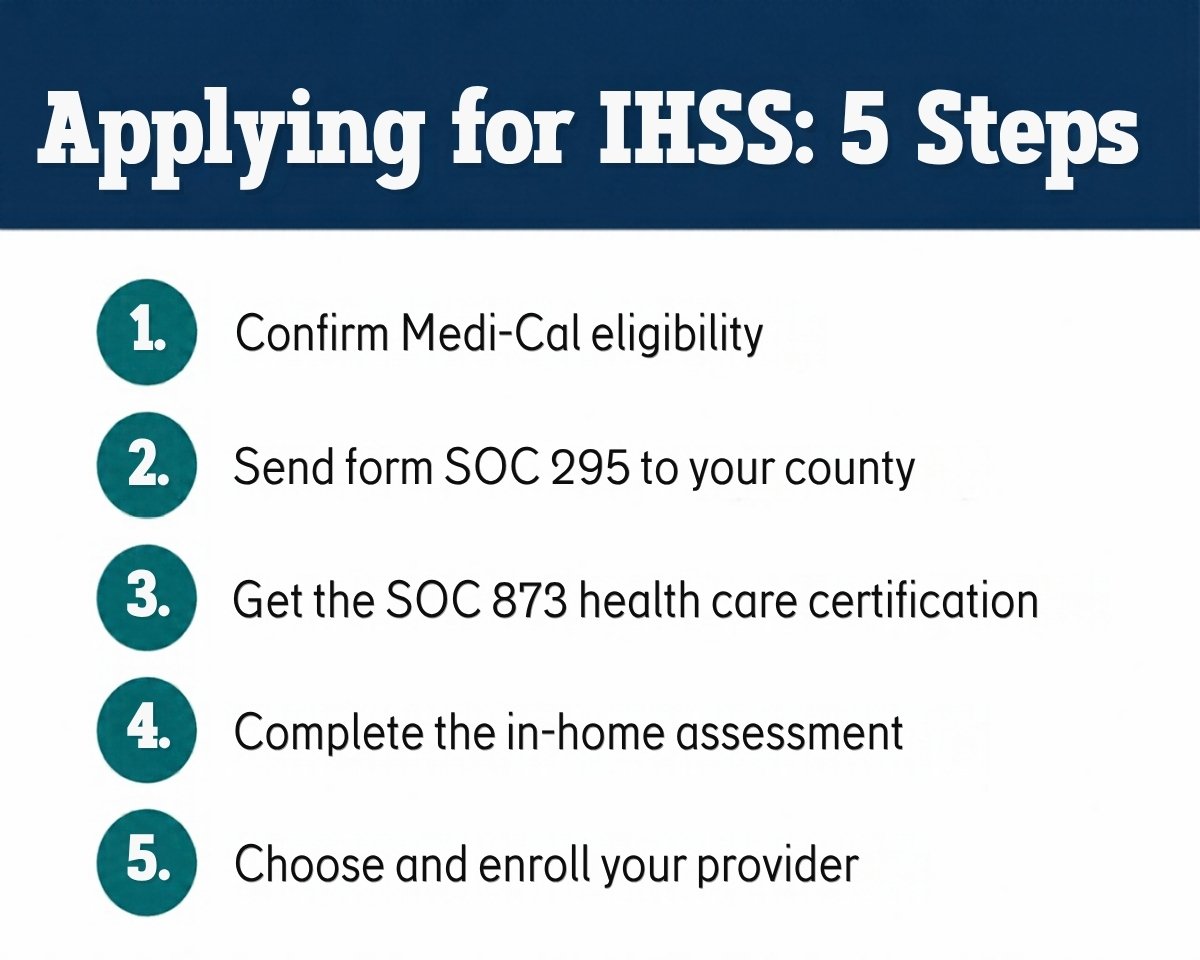
- Confirm Medi-Cal eligibility. IHSS requires a Medi-Cal eligibility determination. If you are not on Medi-Cal yet, your social worker or county office can tell you where to start.
- Submit the application. Complete the IHSS application (form SOC 295) and send it to your county IHSS office. It is available in several languages. You can also usually start by phone.
- Get the Health Care Certification (SOC 873). A licensed health care professional, such as your nephrologist or primary care doctor, must complete this form. It confirms you need help with daily activities to stay safely at home. Applicants typically have 45 days to return it, and services cannot be authorized until the county has it. Health care providers are not allowed to charge you a fee for completing IHSS eligibility forms.
- Complete the in-home assessment. A county social worker visits your home to see what you can and cannot do safely.
- Get your Notice of Action. The county mails a notice saying whether you were approved, which services, and how many hours per month.
- Choose and enroll your provider. Your provider completes enrollment, then submits timesheets for the hours they work.
Getting ready for the home assessment
The assessment is the most important part of the process, and it is easy to undersell yourself. Many people want to look capable when a stranger visits. That is natural, but it can lead to fewer hours than you actually need.
- Schedule the visit so the social worker sees a realistic day, or clearly explain how treatment days differ from off days.
- Describe your worst typical day, not your best one.
- Have a family member or caregiver present if possible. They often remember details you might leave out.
- Keep a short log for a week or two before the visit: what you needed help with, how long it took, and who helped.
- Have your medication list, dialysis schedule, and care team contacts ready.
“On treatment days I come home around two and I’m usually too lightheaded to stand at the stove. My son makes dinner and helps me get in and out of the shower.”
Specific, honest descriptions like that give the social worker something real to work with.
If IHSS is denied or your hours seem too low
You have options. You can ask for a state hearing if you disagree with a county decision, including a denial or a reduction in hours. According to Disability Rights California, you generally have 90 days from the Notice of Action to request a hearing, and appealing quickly, before the change takes effect, may keep your current hours in place while the appeal is decided.
Your needs can also change over time. You can ask for a reassessment whenever your situation changes, such as after a hospital stay, a new access surgery, or a change in how you feel after treatments.
Questions to ask your social worker or county IHSS office
- Am I eligible for Medi-Cal, and is my eligibility already on file?
- Can you help me start an IHSS application or send a referral?
- Who on my care team should complete the SOC 873?
- Would any of my dialysis-related limits count toward personal care or paramedical services?
- Do I qualify for medical accompaniment to dialysis, or should I look at transportation benefits instead?
- What is the current IHSS hourly rate for providers in my county?
- If my family member becomes my provider, what do they need to do to enroll?
Keep your IHSS paperwork and contacts in one place
Use Renal Care Planner’s free tools to track your care team’s names and numbers, your county IHSS contacts, and the questions you want to bring to your next appointment.
My Dialysis Care Team & Contacts →
Questions for My Dialysis Team →
Want it all in one place? The 90-Day Dialysis Planner keeps treatment notes, patterns, and questions together for three months.
Where to go next
- You need help with the application: What Does a Dialysis Social Worker Do?
- A family member is taking on more care: What Caregivers Should Know: Supporting Someone New to Dialysis
- Getting to treatment is the main problem: Dialysis Transportation in California
- You are weighing work against disability: Working vs. Disability When You Start Dialysis
The main thing to remember
IHSS does not look at your diagnosis by itself. It looks at what you cannot safely do at home. If dialysis has made everyday tasks harder, and you have or may qualify for Medi-Cal, it is worth applying. Be honest about your hardest days, get the SOC 873 back on time, and remember that you can appeal or ask for a reassessment if the hours do not match your real life.
Sources
- California Department of Social Services: In-Home Supportive Services (IHSS) Program
- CDSS IHSS Training Academy: Overview of the IHSS Program
- CDSS: Notice to Recipient of Health Care Certification Requirement (SOC 875)
- CDSS: Recipient Designation of Provider (SOC 426A)
- Legal Services of Northern California: IHSS Medical Accompaniment (ACL 20-35 summary)
- Disability Rights California: IHSS Fair Hearings Guide
General education only. This guide provides general information about California’s In-Home Supportive Services program as of October 2026. Eligibility rules, authorized hours, provider pay rates, and procedures vary by person and county and can change. Renal Care Planner is not affiliated with the California Department of Social Services and does not provide legal, benefits, or medical advice. For decisions about your case, contact your county IHSS office, your dialysis social worker, or a legal aid organization such as Disability Rights California.