

A lot of adult children are already doing the work: cooking low-salt meals, doing laundry, helping a parent shower after a draining treatment, and keeping track of the dialysis schedule. If your parent qualifies for California’s In-Home Supportive Services (IHSS) program, you may be able to get paid for some of that help. Getting set up as their provider takes a few steps, and the timesheet rules matter more than most people expect.
Quick answer
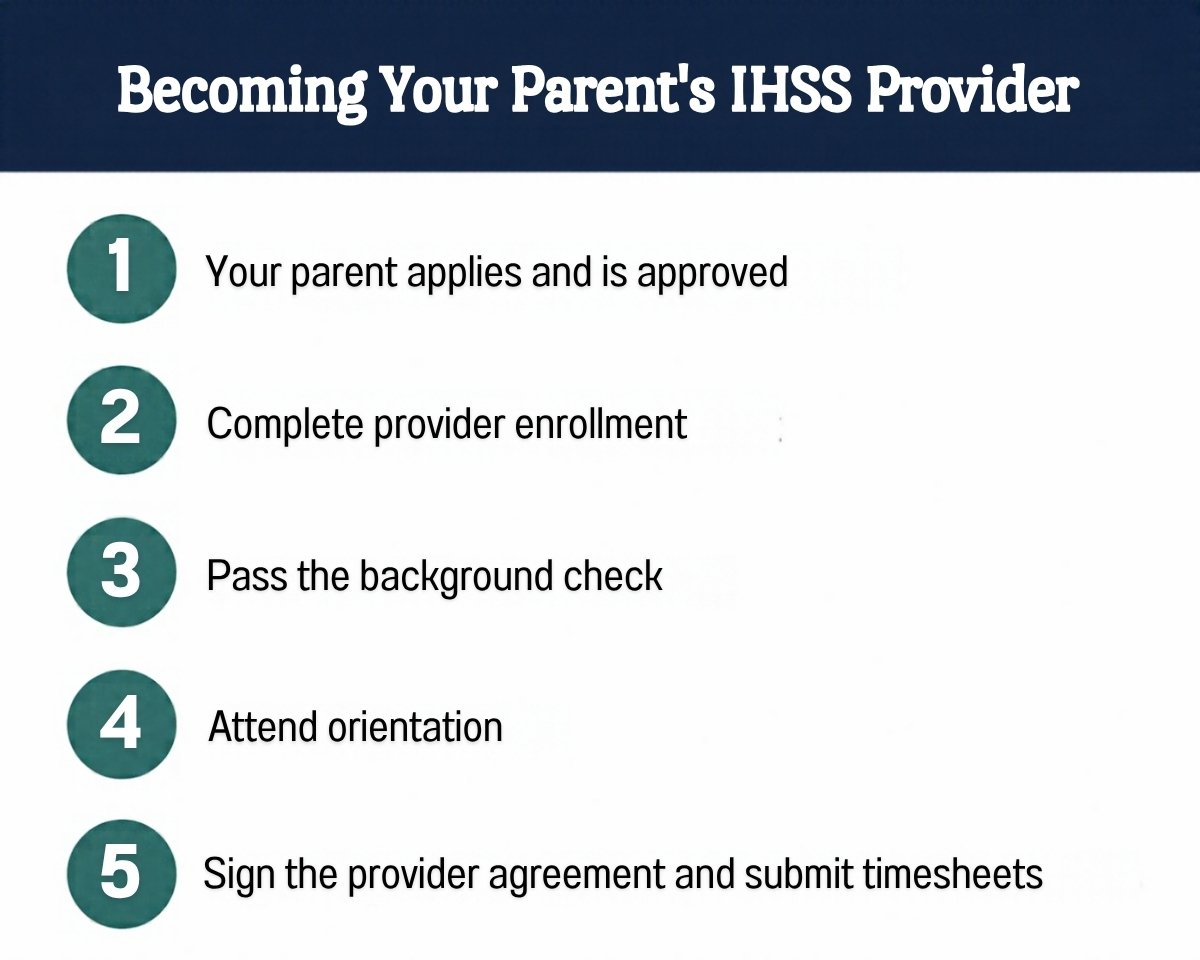
Your parent must first be approved for IHSS. Then they choose you as their provider. Before you can be paid, you must complete the county’s provider enrollment: a background check through Live Scan fingerprinting, a provider orientation, and a signed provider agreement (form SOC 846). After that, you submit timesheets, usually online, for the hours you actually work, up to your parent’s authorized hours. Working more weekly hours than allowed without county approval can lead to violations and, eventually, suspension.
Before you start: your parent has to be approved first
You cannot apply to be paid until your parent has applied for IHSS, completed the county’s home assessment, and received a Notice of Action approving services. If that has not happened yet, start with IHSS for Dialysis Patients in California: What It Covers and How to Apply.
Once approved, your parent is officially your employer. They designate you as their provider using form SOC 426A (Recipient Designation of Provider), and they are responsible for directing and supervising your work. That can feel strange in a family, and we cover it below.
Provider enrollment, step by step
Each county runs its own enrollment process, often through the county IHSS office or the IHSS Public Authority. The core requirements come from the state, so most counties follow a similar path:
- Register and complete the enrollment forms. This usually includes the Provider Enrollment Form (SOC 426) and the Provider Enrollment Agreement (SOC 846). Many counties let you do this online.
- Attend provider orientation. Orientation covers your rights and responsibilities, timesheets, and program rules. Some counties hold it in person and some offer it online.
- Complete the background check. You will get a Live Scan form for fingerprinting at an approved location. Ask your county about the fee and whether it is covered.
- Wait for clearance. The county notifies your parent if you are not eligible. In San Francisco, for example, the county says clearance can take up to six weeks.
- Set up payment and timesheets. Once cleared, you register for electronic timesheets and direct deposit.
The important rule: you cannot be paid for any hours until enrollment is complete. If you help before then, that time is not paid later.
Documents you will likely need
Requirements vary by county, but San Francisco’s provider packet lists a typical set:
- A valid state or U.S. government photo ID
- Your original Social Security card (photocopies are often not accepted)
- The SOC 426A signed by you and your parent
- An active email address
The name on your ID and your Social Security card should match. If they do not, sort that out before orientation.
How IHSS timesheets work
Most providers submit timesheets through the state’s IHSS Electronic Services Portal. You record the hours you worked each day, and your parent reviews and approves them. Payments are issued twice a month.
- Record the time you actually work. Not the time you are on call, and not dialysis waiting-room time unless the county has authorized it. See Can IHSS Pay for Time at Dialysis?
- Stay within the authorized hours. Your parent can never authorize more than their total monthly hours.
- Keep your own simple log. A note on your phone with the date, start and end times, and tasks makes it easy to fill in the timesheet and answer any questions later.
- Submit on time. Late timesheets mean late pay.
Weekly hour limits
IHSS has workweek rules that can trip up family providers who are used to helping whenever it is needed.
- Your parent’s weekly maximum. Counties generally calculate it as the monthly authorized hours divided by about four. You can shift some hours between weeks, but large changes that cause extra overtime may need county approval.
- The 66-hour cap. If you work for more than one recipient, such as both parents, you cannot claim more than 66 hours in a workweek in total.
- Travel time. If you travel between two recipients in one day, claiming more than 7 hours of travel time in a workweek counts as a violation.
What happens if you go over
Placer County’s provider fact sheet describes how violations add up:
- First violation: a notice, and you can request a county review within 10 days.
- Second violation: can be avoided by completing a one-time training within 14 days.
- Third violation: a 90-day suspension as an IHSS provider.
- Fourth violation: one year of ineligibility, then you must re-enroll.
If your parent’s needs have grown and the authorized hours no longer cover reality, the answer is not to work over the limit. Ask the county for a reassessment.
If this sounds familiar
Your mom started dialysis six months ago, and you have been there every treatment day. You are doing far more than her approved hours, and you are tempted to just put it all on the timesheet. Don’t. Log what you actually do for a couple of weeks, then ask for a reassessment with that record in hand. It is a much stronger case, and it keeps you out of violation territory.
Being family and an employee at the same time
The paperwork is the easy part. The harder part is the relationship. A few things help:
- Talk about the arrangement openly. Your parent is the employer on paper. Let them keep as much say as possible over how and when help happens.
- Separate paid tasks from family time. Visiting, watching a show together, or simply being there is still family time, not timesheet time.
- Have a backup. If you get sick or need a break, your parent can add a second provider or ask the county Public Authority about its registry.
- Watch your own limits. Caregiver strain is real. Being paid does not make it go away.
- Check how the income affects you. IHSS wages can interact with your taxes and other benefits. Ask the county and a tax professional how this applies to your situation.
Questions to ask your county IHSS office or Public Authority
- How do I start provider enrollment in this county, online or in person?
- When is the next orientation, and what should I bring?
- How much does Live Scan cost, and is the fee covered?
- What is my parent’s weekly maximum, and how much can I flex hours between weeks?
- What is the current provider pay rate in this county, and are health benefits available?
- How do we request a reassessment if my parent’s needs change?
Keep the schedule and contacts organized
Track your parent’s dialysis days, care team, and IHSS contacts in one place with Renal Care Planner’s free planning tools.
My Dialysis Care Team & Contacts →
Want it all in one place? The 90-Day Dialysis Planner keeps treatment notes, patterns, and questions together for three months.
Where to go next
- Your parent has not applied yet: IHSS for Dialysis Patients in California
- You drive them to treatment: Can IHSS Pay for Time at Dialysis?
- You are new to caregiving: What Caregivers Should Know: Supporting Someone New to Dialysis
- You notice changes between treatments: Dialysis Caregiver Guide: When a Rough Day Becomes a Pattern
The main thing to remember
You cannot be paid until enrollment is finished, so start it as soon as your parent is approved. After that, record only the hours you actually work, stay inside the weekly limits, and ask for a reassessment instead of working over the cap. Getting the paperwork right protects both your paycheck and your parent’s care.
Sources
- CDSS: Recipient Designation of Provider (SOC 426A)
- CDSS: IHSS Provider Enrollment Agreement (SOC 846)
- San Francisco Human Services Agency: IHSS Provider Packet (2026)
- Placer County: IHSS Provider Violations Fact Sheet
- California Department of Social Services: IHSS Program
General education only. This guide summarizes California IHSS provider rules as of October 2026. Enrollment steps, fees, pay rates, and hour rules vary by county and can change. Renal Care Planner is not affiliated with the California Department of Social Services and does not provide legal, tax, or benefits advice. Confirm details with your county IHSS office or Public Authority.