

Blood pressure is one of the numbers you may see most often during hemodialysis. It may be checked before treatment, during treatment, and again before you leave. If your care team also asks you to monitor at home, you can end up with a lot of readings without always knowing how they fit together. This guide explains what those readings can—and cannot—tell you, what context may be worth keeping, and how to bring useful information back to your care team.
Quick answer
Blood pressure around dialysis is affected by more than one factor, including fluid status, medications, cardiovascular health, and what is happening during treatment. Pre- and post-dialysis readings are useful, but they are not the whole picture. If your care team wants home readings, keeping them with simple context—when you measured, whether it was a dialysis day, and how you felt—can make the record more useful to discuss.

Why blood pressure gets so much attention during dialysis
Hemodialysis removes waste and extra fluid from the blood. Because fluid is being removed over several hours, blood pressure can change during a treatment. Your care team looks at blood pressure alongside other information such as your symptoms, weight, fluid removal, medicines, and overall treatment response.
That is why a blood pressure reading is better thought of as one piece of information rather than a score for how well dialysis is going.
If you are trying to understand a drop during treatment specifically, see Why Does Blood Pressure Drop During Dialysis?.
Pre- and post-dialysis readings are not the whole picture
It is easy to focus on the number you see when you arrive or the one you see before leaving. KDIGO’s conference report on blood pressure and volume management in dialysis notes important limitations to routine pre- and post-dialysis measurements and emphasizes that blood pressure targets in dialysis need to be individualized.
Renal Care Planner therefore does not give a universal “good dialysis blood pressure” number. The range that matters for you, and what your team wants you to do about a reading, should come from your own healthcare team.
Home readings can add another piece of the picture
If your care team asks you to monitor blood pressure outside the dialysis center, those measurements can add information from the hours and days between treatments. That is different from a reading taken immediately before or after dialysis.
For step-by-step technique, use How to Check Your Blood Pressure at Home. This article focuses on what to do with the information once you have it. If your care team wants home readings, the Blood Pressure Log gives you a simple place to record them, and the 90-Day Dialysis Planner keeps them next to your treatment notes.
A reading becomes more useful when it has context
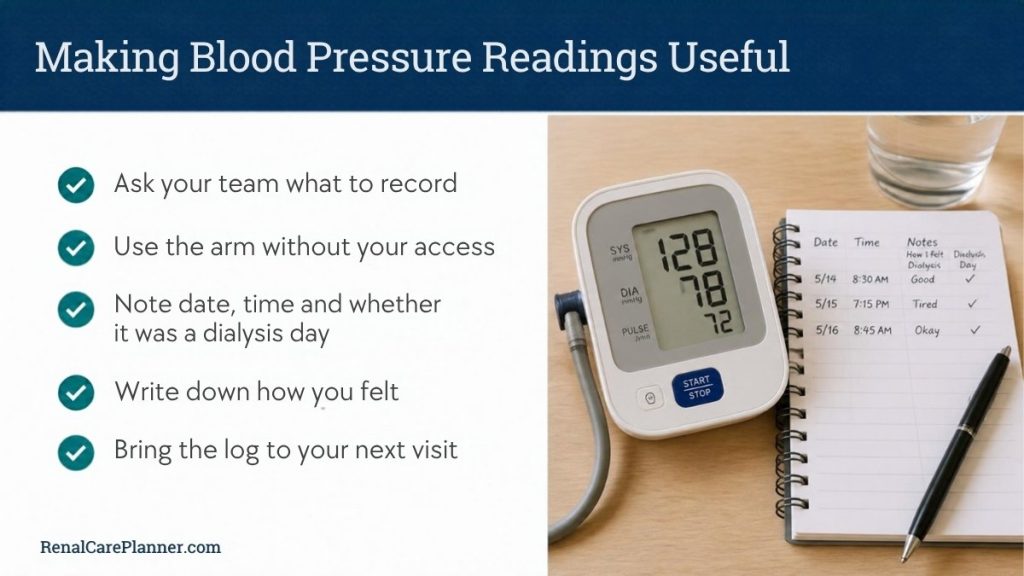
A note that only says “148/82” preserves the number. A note that also says when it was taken, whether it was a dialysis day, and how you felt preserves more of the situation around it.
You do not need to diagnose the meaning of a pattern yourself. The purpose of keeping context is to make it easier to show your care team what you have been noticing.
Use the RCP approach: Track, Recognize, Prepare, Participate
Track
If your care team has asked you to monitor at home, record the information they want you to collect. Depending on their instructions, that might include the date and time, the reading, whether it was a dialysis or non-dialysis day, symptoms you noticed, and a question you want to remember.
Recognize
Look back for something that keeps coming up or seems different from your usual experience. The goal is not to decide what caused it. It is to identify something worth bringing forward.
Prepare
Turn the observation into a question. For example: “I have noticed my readings look different on the mornings after treatment. Do you want me to keep tracking them this way?”
Participate
Bring the record with you. Your care team can decide what is relevant and whether anything needs further evaluation or a change in your care plan.
Protect your access arm when checking blood pressure
If you have a fistula or graft, the National Kidney Foundation advises that blood pressure should not be measured on the access arm. The other arm should be used instead. Ask your dialysis team which arm and monitoring setup they want you to use at home.
For more everyday access precautions, see How to Protect Your Fistula or Graft.
What a standard home blood pressure monitor usually shows
Most home upper-arm monitors focus on familiar measurements such as systolic blood pressure, diastolic blood pressure, and heart rate. For many people, that may be all the information their healthcare team wants them to collect.
Some newer devices provide additional cardiovascular measurements. Those extra measurements are not automatically necessary for someone receiving dialysis, but they may be of interest to people whose healthcare professionals want a broader view of cardiovascular information.
A closer look: CONNEQT Pulse
Affiliate disclosure: Renal Care Planner may earn a commission if you purchase through the link below. This does not change the price you pay or determine the educational guidance in this article.
CONNEQT Pulse is an FDA-cleared, prescription-use upper-arm device that measures brachial blood pressure and heart rate and uses pulse-wave analysis to derive additional central cardiovascular measurements. Its app can store readings and historical trends.
The important distinction for dialysis readers is that CONNEQT Pulse is not a dialysis-management device. Its FDA-cleared purpose is cardiovascular measurement; it does not determine dry weight, set a UF goal, change a dialysis prescription, or tell you how to adjust medication. Those decisions belong with the appropriate healthcare professional.
CONNEQT currently requires a prescription to purchase the Pulse and says its ordering process includes a prescription review. If you are considering any home blood pressure device, ask your care team whether it fits the monitoring they want you to do and which arm you should use.
What should you actually write down?
You do not necessarily need an elaborate tracking system. If your care team wants home monitoring, start by asking: “What information would be useful for me to bring you?”
- Date and time
- The blood pressure reading your team asked you to record
- Whether it was a dialysis or non-dialysis day, if that context is useful to your team
- How you felt or any symptom you want to remember
- A question or follow-up for your next conversation
Renal Care Planner does not tell every dialysis patient when to measure, how often to measure, or what target to use. Those instructions should come from the healthcare professionals responsible for your care.
Do not let the numbers become the whole story
Blood pressure matters, but so does how you feel. A log can help preserve both. If you repeatedly notice dizziness, weakness, cramping, headaches, shortness of breath, or another change around treatment, tell your dialysis team rather than trying to interpret the pattern on your own.
Sometimes the most useful note is simply: “This felt different today. I want to ask about it.”
When a reading or symptom should not wait for your notebook
A tracking tool is for remembering information and preparing conversations. It is not an emergency-response system. Follow the urgent-care instructions your own healthcare team has given you. Seek immediate medical help for symptoms that may represent an emergency, such as chest pain, severe trouble breathing, fainting, or other severe or rapidly worsening symptoms.
Bring better context to the conversation
If your care team has asked you to monitor blood pressure, use a simple notebook or Renal Care Planner’s treatment-day tools to keep readings, symptoms, and questions together instead of relying on memory.
The main thing to remember
A blood pressure reading is a snapshot. Around hemodialysis, the timing of the reading, what was happening around it, and how you felt can all add useful context. If your care team wants you monitoring at home, collect what they ask for, look back for questions worth raising, and bring the record into the conversation. More data is most useful when it helps you and your care team communicate more clearly.
Sources
- KDIGO: Blood Pressure & Volume Management in Dialysis
- KDIGO Controversies Conference Report: Blood Pressure and Volume Management in Dialysis
- National Kidney Foundation: Key Points About Dialysis for Kidney Failure
- U.S. Food and Drug Administration: CONNEQT Pulse 510(k) K221742
- CONNEQT Health: CONNEQT Pulse product information
General education only. This guide does not provide individualized blood pressure targets, diagnose symptoms, or recommend changes to dialysis, medicines, fluid removal, or other treatment. Follow the monitoring and treatment instructions from your own healthcare team.