

When a husband or wife starts dialysis, the other spouse often becomes the driver, cook, nurse’s helper, and paperwork manager almost overnight. Many spouses then hear that California’s IHSS program can pay family caregivers and wonder whether that includes them. It can, but spouses follow different rules than adult children or friends. Here is what those rules mean in plain language.
Quick answer
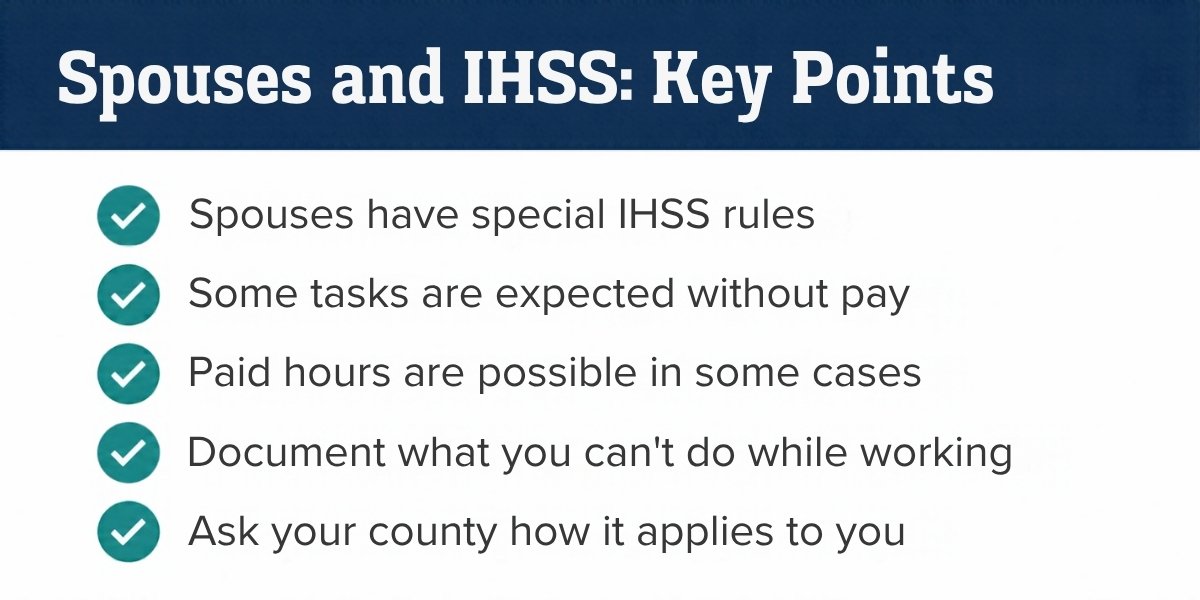
Under California’s “able and available spouse” rule, a spouse who lives at home is presumed to handle many IHSS tasks, such as housework, laundry, shopping, and usually meal preparation, without pay. A spouse can be hired and paid for personal care (like bathing and dressing) and paramedical services. A spouse can be paid for medical accompaniment and protective supervision only if they had to leave full-time work, or cannot take full-time work, because no other suitable provider is available. If the spouse is working, ill, or otherwise unavailable, the county can authorize another provider for some tasks.
The “able and available spouse” rule
IHSS treats a spouse living in the home differently from other relatives. Unless shown otherwise, the county presumes that a spouse is both able (physically and mentally capable) and available (home and not prevented by work, illness, or another unavoidable reason) to help with certain household tasks as part of the marriage.
That presumption can be overcome. If the spouse has a medical reason they cannot do a task, or is away for work or another unavoidable reason, the county can authorize paid help from someone else.
What a spouse can be paid for
- Personal care services: help with bathing, dressing, grooming, toileting, eating, and moving around. A recipient can hire their spouse for these at any time, and the able-and-available test does not apply.
- Paramedical services: certain health-related tasks done under the direction of a licensed health care professional. These can also be paid to a spouse.
- Medical accompaniment and protective supervision: payable to a spouse only under the full-time work exception below.
What is usually not paid when a spouse is available
According to Orange County’s IHSS policy on the able and available spouse rule, when a spouse is able and available these are treated as already met by the spouse, so no one is paid for them:
- Domestic services (housecleaning) and related services such as laundry and shopping
- Heavy cleaning and yard hazard removal
- Meal preparation
- Medical accompaniment and protective supervision (unless the full-time work exception applies)
Your county applies these rules case by case, so the details of your own household matter.
The full-time work exception
A spouse may be paid for medical accompaniment and protective supervision if they had to leave full-time employment, or are prevented from taking full-time work, because no other suitable provider is available to care for the recipient.
For dialysis families, this matters because accompaniment is the service most tied to treatment days. Keep in mind that accompaniment itself has limits, including that waiting-room time during a long treatment is generally not paid. See Can IHSS Pay for Time at Dialysis?
When a spouse is working, sick, or away
A spouse is not considered available when they are away because of employment, their own health, or another unavoidable reason. In those cases, the county can authorize a non-spouse provider, such as an adult child or a friend, for the tasks that need to happen during that time.
- Working spouse: If your spouse works during the day and you need meals prepared or help at home during those hours, tell the county your spouse’s work schedule.
- Spouse with health limits: If your spouse has their own medical condition that prevents tasks like lifting laundry or cleaning, the county may accept medical verification of that inability.
- Spouse away overnight or longer: If a spouse is out of the home for 24 hours or more for work, health, or another unavoidable reason, hours may be authorized for another provider for that period.
If this sounds familiar
You are 68, your husband started dialysis last spring, and you have been helping him shower and dress every morning. You assumed IHSS was only for paying the kids. In fact, personal care is one of the services a spouse can be paid for. If he qualifies for IHSS, it is worth asking the county about naming you as his provider for those tasks.
How this can look for a dialysis household
These examples show how the rules often apply. They are not guarantees. The county decides based on its own assessment.
- Retired spouse at home: Likely paid for personal care, such as help bathing and dressing after treatment. Housework, laundry, and meals are likely treated as the spouse’s unpaid responsibility.
- Spouse who works full time: An adult child may be authorized to help with meals or personal care while the spouse is at work.
- Spouse who quit a job to provide care: May also qualify for paid medical accompaniment if no other suitable provider is available.
- Spouse with their own disability: With medical verification, another provider may be authorized for tasks the spouse cannot do.
How a spouse becomes the paid provider
The steps are the same as for any IHSS provider: the recipient designates the spouse as their provider, and the spouse completes enrollment, including a background check, orientation, and the provider agreement. Our guide to becoming an IHSS provider walks through enrollment and timesheets. The process is written for adult children but works the same way for spouses.
Questions to ask your county IHSS social worker
- Which of my authorized services can my spouse be paid for?
- Does the able and available spouse rule reduce any of my hours, and which ones?
- My spouse works. Can another provider cover tasks during their work hours?
- My spouse has health limits. What medical verification do you need?
- My spouse left a full-time job to care for me. Does that qualify them to be paid for medical accompaniment?
- How do we appeal if we disagree with the decision?
Bring your questions to the right people
Write down your questions for the county and your dialysis social worker so you don’t forget them in the middle of an appointment.
Questions for My Dialysis Team →
My Dialysis Care Team & Contacts →
Want it all in one place? The 90-Day Dialysis Planner keeps treatment notes, patterns, and questions together for three months.
Where to go next
- Your spouse has not applied yet: IHSS for Dialysis Patients in California
- You drive your spouse to dialysis: Can IHSS Pay for Time at Dialysis?
- You are new to caregiving: What Caregivers Should Know: Supporting Someone New to Dialysis
- The strain is building: What Does a Dialysis Social Worker Do?
The main thing to remember
Spouses can be paid through IHSS, but mostly for hands-on personal care and paramedical tasks. Housework and meals are usually treated as part of the marriage when a spouse is home and able. If you are working, have your own health limits, or gave up a full-time job to provide care, tell the county. Those details can change what is authorized and who can be paid.
Sources
- Orange County Social Services Agency: IHSS Policy 1015, Able and Available Spouse
- Legal Services of Northern California: IHSS Able and Available Spouse Rule
- California Department of Social Services: IHSS Program
General education only. This guide summarizes California IHSS spouse rules as of October 2026, based on state regulations as described in county policy and legal aid summaries. Counties apply these rules to each case, and policies can change. Renal Care Planner is not affiliated with the California Department of Social Services and does not provide legal or benefits advice. Confirm your situation with your county IHSS office or a legal aid organization.