

Search for “dialysis shirt” online and you will find specialized shirts with zippers, snaps, ports, and openings. They can be genuinely useful, but they are not the only solution. For some people, a regular loose T-shirt works perfectly. For others, a simple DIY modification is more practical than buying a specialized garment.
Affiliate disclosure: This page contains affiliate links. If you purchase through one of these links, Renal Care Planner may earn a commission at no additional cost to you.
Quick answer
The right choice depends less on the label “dialysis clothing” and more on whether the garment gives staff clear access to your actual fistula or graft, stays away from needles and bloodlines, avoids compressing the access arm, and keeps you comfortable for several hours.
What the clothing needs to accomplish
The National Kidney Foundation recommends avoiding tight or constraining clothing over a dialysis access. Whatever you wear should allow the treatment team to reach and monitor the access without creating pressure on the arm.
A useful treatment-day garment should:
- Allow staff to reach the access easily.
- Stay away from needles and bloodlines.
- Avoid compressing the access.
- Be comfortable enough for several hours.
- Be easy to wash.
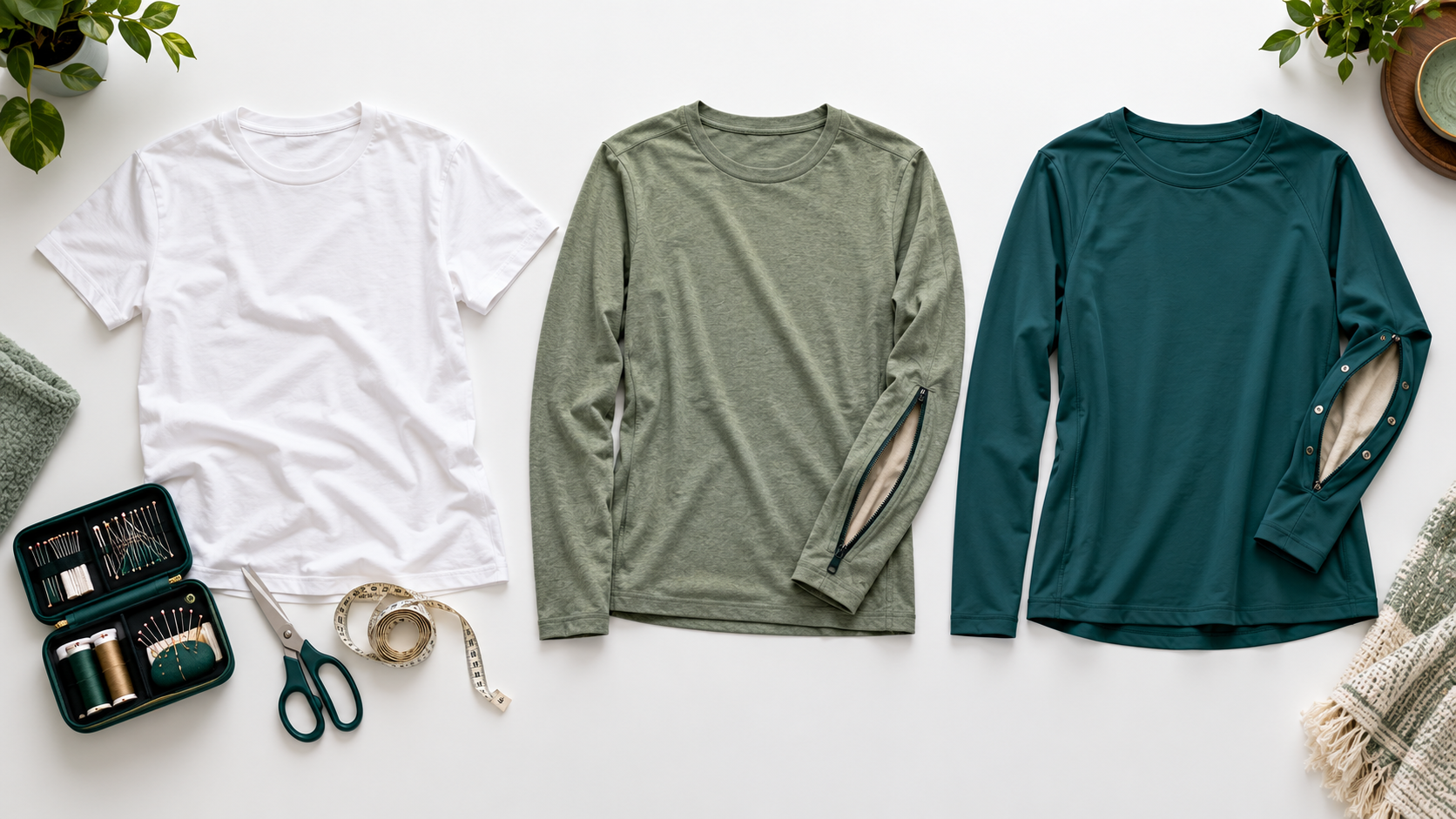
Option 1: A regular short-sleeve shirt
Cost: Lowest
Modification needed: None
Warmth: Low
Access flexibility: Good when the access is easily exposed
If a loose short sleeve completely exposes the area your dialysis team uses, you may not need anything more complicated. Add a blanket for warmth and you have solved most of the problem.
This is often the best starting point for people with an easily accessible upper-arm fistula or graft.
Option 2: A DIY access shirt
Cost: Low
Modification needed: Yes
Warmth: Depends on garment
Access flexibility: Potentially excellent
The biggest advantage of DIY is customization. A manufacturer does not know exactly where your arterial and venous needle sites are. A zipper, snap, or hook-and-loop opening can be placed where your own dialysis team actually needs access.
A simple DIY concept
Start with a loose long-sleeve shirt or sweatshirt. Create an opening along the sleeve that exposes the entire area normally used for cannulation. The opening should be generous rather than barely large enough for the needles.
Possible closures include snaps, a zipper, or hook-and-loop tape.
Before modifying the shirt
Put it on and identify where your access sits while you are in a normal seated position. The important area is not just where the scar begins and ends. It is where your team needs to clean, cannulate, secure, and monitor the access.
If possible, ask your dialysis nurse or technician whether the proposed opening gives them enough room before cutting the garment.
Common DIY problems
- Tight sleeve cuffs
- Unfinished fabric edges
- Zippers that press directly on the access
- Openings that are too small
- Closures that are hard to operate one-handed
- Heavy fabric that falls back over the needles
See the full RCP DIY dialysis-access shirt tutorial.
Option 3: Purpose-built adaptive clothing
Cost: Highest
Modification needed: None
Warmth: Often better
Access flexibility: Depends on the design and your access location
Commercial adaptive clothing becomes attractive when you want something finished, reusable, and designed to open around common medical-access areas.
KickIt Recovery Set
The Recovery Set uses long sleeves with arm and underarm zipper access and a front-opening top. It may suit someone who wants a complete treatment-day outfit with built-in access.
KickIt Hospital Pajamas
The Hospital Pajamas use snap sleeves designed for easier medical access. They may appeal to someone who prefers softer, relaxed treatment clothing.
KickIt Infusion Jacket
The Infusion Jacket uses a front zipper and openings beneath the sleeves. Rather than replacing your shirt, it may make the most sense as a removable warm layer.
Explore KickIt Recovery Wear →
Side-by-side comparison
| Option | Cost | Warmth | Custom fit to your access | Ready to use |
|---|---|---|---|---|
| Loose short-sleeve shirt | $ | Low | Depends | Yes |
| DIY access shirt | $ | Medium to high | Excellent | Requires modification |
| Adaptive access clothing | $$$ | Medium to high | Depends on design | Yes |
| Adaptive jacket over a shirt | $$ to $$$ | High | Depends on opening | Yes |

Which one should you choose?
Choose a regular shirt if:
Your access is already completely exposed and you are comfortable using a blanket for warmth.
Choose DIY if:
You want a low-cost solution tailored to your actual needle sites and you or someone you know can install closures reliably.
Choose adaptive clothing if:
You want a finished garment, more coverage, and built-in access without modifying your own clothes.
One important limitation
Do not buy something simply because the product page says “dialysis.” Look at the actual opening. A perfectly designed sleeve opening that sits several inches away from your own cannulation sites is not useful to you.
Your anatomy, access type, and needle placement matter more than the product label.
The bottom line
You do not need an expensive dialysis shirt to be prepared for treatment. Sometimes the best answer is a loose T-shirt. Sometimes a simple DIY modification works beautifully. Sometimes paying more for purpose-built clothing is worth it because warmth, convenience, privacy, and repeated use matter to you.
The right choice is the one that gives your treatment team clear access while helping you feel comfortable in the chair.
Related Renal Care Planner resources
- How to Modify a Shirt for Easier Dialysis Access
- Dialysis Clothing Guide
- Fistula vs. Graft vs. Catheter
General education only. Renal Care Planner provides general educational information and planning resources. Clothing suggestions do not replace guidance from your dialysis care team or your facility’s policies.