
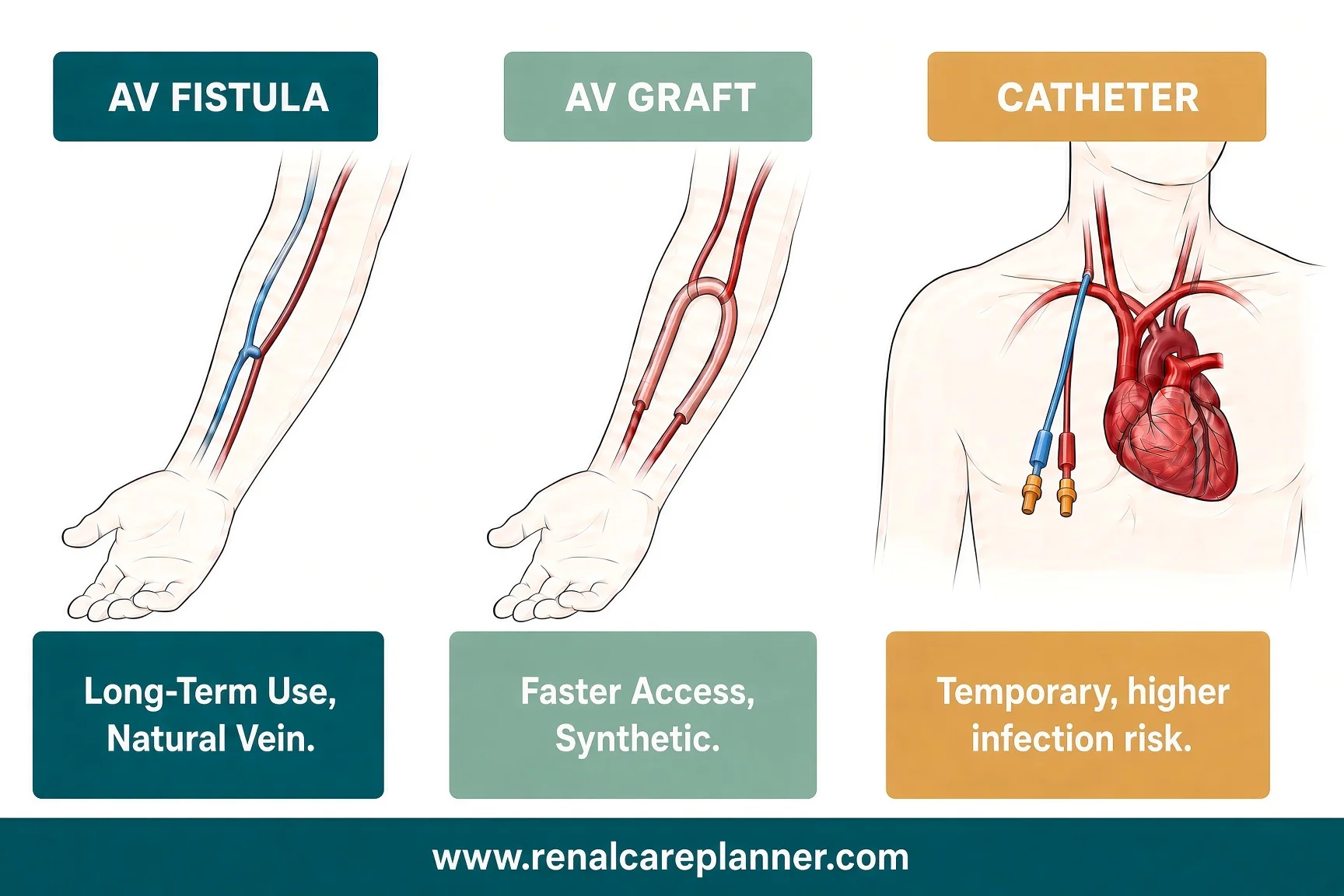
Before hemodialysis can clean your blood, your care team needs a safe way to move blood from your body to the dialysis machine and back again. This pathway is called your vascular access. The three main types are an arteriovenous (AV) fistula, an AV graft, and a central venous catheter.
Each access type works differently. Some need time to heal before they can be used, some can be ready sooner, and each has its own care needs and risks. Your access plan should be based on your blood vessels, health, treatment timeline, and personal goals—not on a one-size-fits-all rule.
The short answer
- AV fistula: A surgeon connects one of your arteries to one of your veins, usually in an arm. When it is usable, a fistula generally has the lowest infection risk and can last a long time.
- AV graft: A soft synthetic tube connects an artery and a vein, usually in an arm. A graft can often be used sooner than a fistula, but it is more likely than a fistula to develop infection or clotting problems.
- Central venous catheter: A flexible tube is placed into a large vein, often in the neck or upper chest. It can provide access quickly, but it has the highest bloodstream-infection risk of the three types.
Fistula vs. graft vs. catheter at a glance
| Access type | What it is | How treatment connects | Main considerations |
|---|---|---|---|
| AV fistula | A direct connection between your own artery and vein | Two dialysis needles are placed for each treatment | Often durable and has the lowest infection risk, but it needs time to develop and is not possible for everyone |
| AV graft | A soft synthetic tube connecting an artery and vein | Two dialysis needles are placed into the graft for each treatment | Often usable sooner than a fistula, but clotting and infection are more common than with a fistula |
| Central venous catheter | A tube placed into a large central vein, with two capped ends outside the body | Dialysis tubing connects to the two catheter limbs; an arm access is not needled | Can be used quickly, but has the highest infection risk and requires careful dressing and water precautions |
This comparison is a starting point. The best access for you may also depend on previous access surgeries, the condition of your blood vessels, other medical conditions, how soon dialysis is needed, and which treatment options you may use in the future.
What does vascular access do?
During hemodialysis, blood travels through tubing to a dialyzer, sometimes called an artificial kidney. The dialyzer removes extra fluid and waste, and the cleaned blood returns to your body. A vascular access must allow enough blood flow for this process while being dependable enough for repeated treatments.
The access itself is not the dialysis treatment. It is the entry and return pathway that makes treatment possible. If you want a step-by-step view of the full process, read What Happens During Hemodialysis?
What is an AV fistula?
An AV fistula is made during a surgical procedure that connects an artery directly to a vein, most often in the forearm or upper arm. The stronger blood flow helps the vein become larger and stronger so it can support repeated dialysis treatments.
A new fistula is not usually ready immediately. It needs time to heal and develop—a process often called maturation. The amount of time varies. Your access surgeon and dialysis team will examine the fistula and decide when it is ready to use.
Why a fistula is often preferred
- It generally has the lowest risk of infection among the three access types.
- It can provide strong blood flow for dialysis.
- It can last for many years when it develops well and remains healthy.
What to keep in mind
- It needs time to mature before it can be used.
- Some fistulas do not develop enough for reliable dialysis.
- Two needles are placed for each treatment.
- Your blood vessels or health history may make another access type more appropriate.
What is an AV graft?
An AV graft uses a soft, flexible synthetic tube to create a pathway between an artery and a vein. The tube sits under the skin, most often in an arm. Dialysis needles are placed into the graft rather than directly into a natural vein.
A graft can often be used sooner after surgery than a fistula, although the timing depends on the type of graft, healing, and your care team’s assessment. A graft may be recommended when a person’s veins are not likely to support a fistula or when another clinical consideration makes it a better fit.
Possible advantages of a graft
- It may be ready for use sooner than a fistula.
- It can provide reliable access when a fistula is not a good option.
- It is completely under the skin when healed.
What to keep in mind
- Grafts are more likely than fistulas to develop blood clots or infection.
- They may need procedures to restore blood flow or repair a narrowing.
- Two needles are placed for each dialysis treatment.
What is a dialysis catheter?
A hemodialysis catheter is a flexible tube placed into a large central vein. It is commonly positioned in the neck, with the external portion resting on the upper chest. The catheter has two limbs: one carries blood to the dialysis machine and the other returns the cleaned blood.
A catheter can provide access quickly. It is often used when dialysis must begin before a fistula or graft is ready, or when an arm access cannot be created or used. Some people need a catheter for longer because of their individual medical situation.
Possible advantages of a catheter
- It can usually be used soon after placement.
- It does not require an arm access to be needled during each treatment.
- It can make dialysis possible while another access is healing or being planned.
What to keep in mind
- Catheters have the highest risk of bloodstream infection.
- They can have flow problems or develop blood clots.
- The dressing must stay clean, dry, and secure.
- Bathing and swimming require special precautions. Follow your dialysis team’s instructions rather than removing or changing the dressing yourself.
What happens before the treatment starts?
Your dialysis team checks the access before connecting you. The exact routine depends on your access type and facility, but it may include looking for redness, swelling, drainage, or skin changes and checking whether blood is flowing through the access.
With a fistula or graft, staff usually clean the skin carefully and place two needles—one for blood going to the machine and one for blood returning to you. With a catheter, staff wear a mask and use careful infection-prevention steps while connecting the dialysis tubing to the two catheter limbs.
If you are preparing for your first visit, the guide Your First Hemodialysis Treatment: What to Expect explains the check-in, setup, treatment, and recovery process.
How is the right access chosen?
There is no single access that is right for every person. Current vascular-access guidance emphasizes planning around the individual. Your kidney doctor, access surgeon, dialysis team, and you may consider:
- How soon you may need hemodialysis
- The size and condition of your arteries and veins
- Previous access surgeries, catheters, or blood-vessel procedures
- Other health conditions and your risk of complications
- Your expected treatment plan, including home dialysis, transplant, or another dialysis option
- Your preferences, daily activities, and long-term goals
A fistula is often preferred when it is likely to work well and fits the person’s treatment plan. That does not make a graft or catheter a personal failure. An access may be temporary, may change over time, or may be the safest realistic choice for a particular patient.
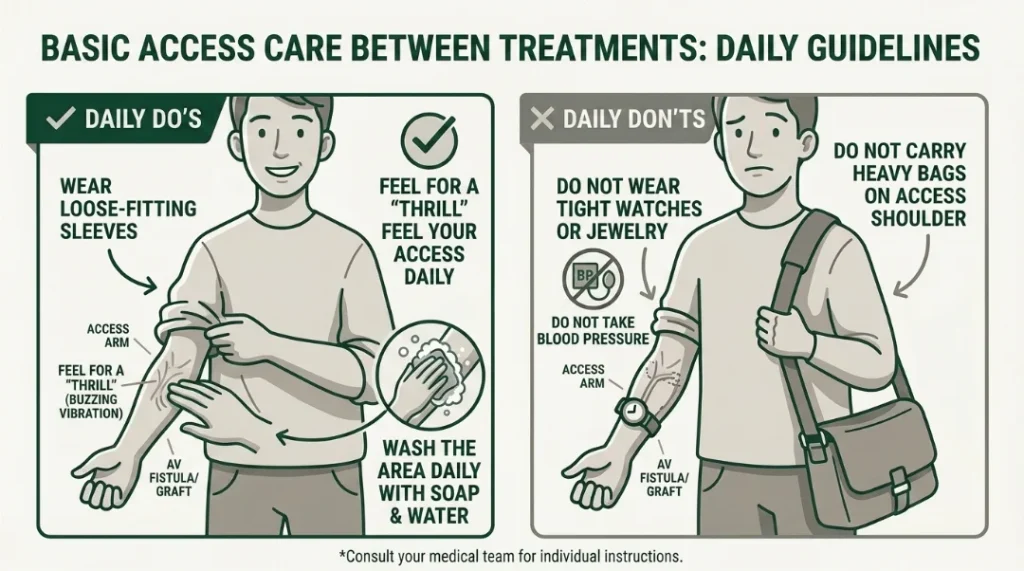
Basic access care between treatments
Your dialysis center will give you instructions specific to your access. Common guidance includes the following.
For a fistula or graft
- Keep the skin clean and check the area each day.
- If your care team has taught you how, gently check for the vibration called a thrill and report a change or loss of it promptly.
- Do not allow blood-pressure cuffs, routine blood draws, or IV lines on the access arm unless your kidney team specifically directs otherwise.
- Avoid tight sleeves, watches, jewelry, or heavy pressure over the access.
- After treatment, use the pressure method your clinic teaches you and do not pick at the needle sites.
Clothing that gives staff easy access to the site can make setup less awkward. See What to Wear to Dialysis or the practical DIY dialysis-access shirt guide.
For a catheter
- Keep the dressing clean, dry, and secured.
- Do not open the caps, pull on the tubing, or remove the dressing unless your care team has specifically trained and directed you to do so.
- Follow your clinic’s instructions for showering. Do not submerge the catheter in a bath, pool, hot tub, lake, or other water.
- Tell staff if the dressing becomes wet, loose, dirty, or damaged.
When should you call your dialysis team?
Contact your dialysis team promptly if you notice:
- Redness, warmth, swelling, drainage, or worsening pain around the access
- Fever or chills, especially during or after dialysis
- A change or loss of the fistula or graft’s thrill, if you have been taught to check it
- A hand that becomes unusually cold, pale, blue, numb, weak, or painful on the access side
- Bleeding that lasts longer than usual after treatment
- A catheter dressing that is wet, loose, dirty, or no longer covering the site
- A catheter that appears to have moved, cracked, or become damaged
If access bleeding will not stop using the pressure method your clinic taught you, seek urgent medical help. Your dialysis center should also tell you whom to call after hours and which symptoms require emergency care.
Questions to ask your care team
- Which access type are you recommending for me, and why?
- When is it expected to be ready for dialysis?
- How should I protect it while it heals?
- What should normal blood flow, skin, and soreness feel like?
- Which changes should I report immediately?
- Who should I call if I have a concern outside clinic hours?
- If I have a catheter now, is another access being planned?
Frequently asked questions
Does a fistula or graft always require two needles?
Standard hemodialysis through a fistula or graft usually uses two needles: one carries blood to the dialysis machine and one returns it. Your dialysis team decides the needle placement and technique based on your access and treatment prescription.
Does a catheter mean I will never need needles?
A catheter connects to the dialysis tubing without placing needles into an arm access at each treatment. You may still need blood tests, medications, or other medical procedures that involve needles.
Can an access type change later?
Yes. A catheter may be used while a fistula or graft heals. An access can also develop a problem, stop working, or no longer fit a person’s treatment plan. The care team may recommend a repair, replacement, or different access type.
Can I sleep on my access arm?
Avoid prolonged pressure over a fistula or graft. Ask your access team what is safe for your access location and usual sleep position. For a catheter, avoid pulling, bending, or placing pressure on the external tubing.
Which access has the lowest infection risk?
According to the CDC and National Kidney Foundation, a fistula generally has the lowest infection risk, while a central venous catheter has the highest. Any access can become infected, so daily awareness and careful connection practices still matter.
Related guides
- Free Questions for Your Dialysis Team Worksheet (PDF)
- Can You Swim With a Dialysis Access?
- Can Dialysis Patients Travel?
Trusted sources
- National Kidney Foundation: Hemodialysis Access
- National Institute of Diabetes and Digestive and Kidney Diseases: Hemodialysis
- Centers for Disease Control and Prevention: Preventing Bloodstream Infections in People on Dialysis
- Centers for Disease Control and Prevention: Infections and Patients on Dialysis
- KDOQI Clinical Practice Guideline for Vascular Access
This article is for general education and is not a substitute for medical advice. Your access type, care instructions, and warning signs may differ. Follow the plan provided by your nephrologist, access surgeon, and dialysis team.