

Searching for renal diet recipes can get frustrating fast. One list says to avoid a food completely, another calls it kidney-friendly, and many recipes are written for earlier-stage kidney disease rather than dialysis. This collection is different: it is built for people receiving hemodialysis and focuses on practical, lower-sodium meals with ingredients that are commonly easier to fit into a dialysis eating plan.
Quick answer: There is no single renal diet that works for every dialysis patient. Potassium, phosphorus, fluid, protein, diabetes, appetite, and remaining kidney function can all change what fits. Use these recipes as starting points and adjust them with your renal dietitian based on your labs and treatment plan.

Affiliate disclosure: This article may contain affiliate links. If you buy through one of these links, Renal Care Planner may earn a commission at no additional cost to you. See our Affiliate Disclosure.
What makes a recipe more dialysis-friendly?
For many people on in-center hemodialysis, the big nutrition themes are sodium, potassium, phosphorus, protein, and fluid. The National Kidney Foundation notes that most people on hemodialysis need more protein while also paying attention to sodium, phosphorus, potassium, and fluid. Your actual limits depend on your labs and treatment schedule.
- Cook from basic ingredients when you can. Packaged and processed foods often contribute extra sodium and phosphate additives.
- Use herbs, garlic, lemon, pepper, vinegar, and salt-free spice blends for flavor. Some salt substitutes contain potassium chloride, so check the ingredient list.
- Keep portions in mind. A lower-potassium food can become a larger potassium load when the serving gets much bigger.
- Include protein. People on hemodialysis commonly need more protein than people with earlier-stage CKD.
If you are brand new to dialysis nutrition, start with What Can You Eat on Hemodialysis? before using any online meal plan as a rulebook.
Easy renal diet breakfast recipes
1. Cinnamon apple Cream of Wheat
Makes 1 serving
- 1 serving Cream of Wheat, prepared with water according to the package
- 1/2 small apple, peeled if preferred and diced
- 1/4 teaspoon cinnamon
- 1 teaspoon honey or maple syrup, optional
How to make it: Prepare the cereal with water. Stir in the diced apple and cinnamon during the final minute of cooking. Add a small amount of honey or maple syrup if you want more sweetness.
Why it works as a starting point: It uses a simple cooked cereal and apple rather than a breakfast built around salty breakfast meats or large amounts of dairy.
2. Egg-white pepper scramble with toast
Makes 1 serving
- 3 egg whites
- 1/4 cup diced bell pepper
- 2 tablespoons diced onion
- 1 teaspoon olive oil
- Black pepper, garlic powder, or dried herbs
- 1 slice toast
How to make it: Heat the olive oil in a small skillet. Cook the pepper and onion until softened. Add egg whites and seasonings and scramble until set. Serve with toast.
3. Blueberry cinnamon French toast
Makes 1 serving
- 2 slices bread
- 1 whole egg plus 1 egg white
- 1/4 teaspoon cinnamon
- 1/3 cup blueberries
- 1 teaspoon oil for the pan
How to make it: Whisk the egg, egg white, and cinnamon. Dip the bread lightly in the mixture and cook in a lightly oiled skillet until browned on both sides. Top with blueberries.
Easy renal diet lunch recipes
4. Lemon-herb chicken rice bowl
Makes 1 serving
- 3 ounces cooked skinless chicken breast
- 2/3 cup cooked white rice
- 1/2 cup shredded cabbage
- 1/4 cup sliced cucumber
- 1 teaspoon olive oil
- Fresh lemon juice
- Black pepper, parsley, garlic powder, or dill
How to make it: Add rice to a bowl and top with chicken, cabbage, and cucumber. Mix olive oil, lemon juice, and herbs into a quick dressing and spoon over the top.
5. Apple-cucumber chicken salad
Makes 1 serving
- 3 ounces cooked chicken, chopped
- 1/4 small apple, diced
- 1/4 cup cucumber, diced
- 1 tablespoon mayonnaise
- Black pepper and dill
- Lettuce leaves, bread, or a small flour tortilla for serving
How to make it: Mix chicken, apple, cucumber, mayonnaise, and seasonings. Serve as a lettuce wrap, sandwich, or small wrap.
6. Cabbage and turkey skillet
Makes 2 servings
- 6 ounces lean ground turkey
- 2 cups shredded cabbage
- 1/2 cup sliced bell pepper
- 1/4 cup chopped onion
- 1 tablespoon olive oil
- Garlic powder, smoked paprika, and black pepper
- 1 cup cooked white rice for serving
How to make it: Brown the turkey in a skillet. Add olive oil, cabbage, pepper, and onion. Cook until the vegetables soften and the turkey is fully cooked. Season with garlic powder, paprika, and pepper. Divide into two portions and serve each with rice.
Easy renal diet dinner recipes
7. Garlic-herb chicken with green beans and rice
Makes 2 servings
- 6 ounces chicken breast, divided into two portions
- 1 cup green beans
- 1 1/3 cups cooked white rice
- 1 tablespoon olive oil
- Garlic powder, parsley, black pepper, and lemon
How to make it: Season the chicken with garlic powder, parsley, and pepper. Cook in olive oil until the thickest part reaches a safe temperature. Steam or saute the green beans. Serve with rice and a squeeze of lemon.
8. Baked white fish with couscous and cucumber salad
Makes 2 servings
- Two 3-ounce portions of cod, tilapia, or another plain white fish
- 1 cup cooked couscous
- 1 cup chopped cucumber and lettuce
- 1 tablespoon olive oil
- Lemon juice, dill, garlic powder, and black pepper
How to make it: Bake the fish until it flakes easily and is fully cooked. Season with lemon, dill, garlic powder, and pepper. Serve with couscous and a cucumber-lettuce salad dressed with olive oil and lemon.
9. Chicken and cabbage pasta
Makes 2 servings
- 6 ounces cooked chicken breast, sliced
- 2 cups cooked pasta
- 1 1/2 cups thinly sliced cabbage
- 1/2 cup bell pepper strips
- 1 tablespoon olive oil
- Garlic powder, oregano, black pepper, and lemon juice
How to make it: Saute cabbage and peppers in olive oil. Add cooked chicken and pasta. Season with garlic powder, oregano, pepper, and lemon juice and toss until hot.
10. Simple chicken tacos with cabbage slaw
Makes 2 servings
- 6 ounces cooked chicken, sliced
- 4 small flour tortillas
- 1 cup shredded cabbage
- 1/2 cup sliced bell peppers
- 1 tablespoon olive oil
- Lime juice, cumin, garlic powder, and black pepper
How to make it: Warm the chicken with cumin, garlic powder, and pepper. Toss cabbage and pepper with olive oil and lime. Divide between the tortillas.
Easy renal diet snack recipes
11. Cinnamon apple toast
Makes 1 serving
- 1 slice toast
- 1/2 small apple, thinly sliced
- Cinnamon
- 1 teaspoon honey, optional
How to make it: Toast the bread, layer with apple slices, sprinkle with cinnamon, and add a small drizzle of honey if desired.
12. Herb popcorn
Makes 1 snack serving
- 2 cups plain air-popped popcorn
- 1 teaspoon olive oil
- Garlic powder, onion powder, paprika, dill, or another salt-free herb blend
How to make it: Toss the popcorn with olive oil and your seasoning of choice. Check packaged seasoning blends for sodium and potassium chloride.
Simple swaps that can make recipes easier to fit
| Instead of | Try | Why people use the swap |
|---|---|---|
| Salt-heavy seasoning packets | Garlic, herbs, lemon, vinegar, pepper | Helps control added sodium |
| Processed deli meat | Freshly cooked chicken, turkey, fish, or eggs | Often reduces sodium and phosphate additives |
| Tomato-heavy sauces | Olive oil, lemon, herb, or garlic-based sauces | Can make potassium easier to manage for people who have a potassium limit |
| Large amounts of cheese | Use smaller amounts or flavor with herbs and acid instead | Can reduce sodium and phosphorus |
| Salt substitutes | Salt-free herbs and spices | Many salt substitutes contain potassium chloride |
Want more renal diet recipes without building every meal yourself?
See our Best Kidney-Friendly Cookbooks for a Renal Diet. We separate beginner books from structured meal-planning books and point out an important issue for dialysis patients: many renal cookbooks are written for pre-dialysis CKD, where protein advice may be different.
If you want a beginner-focused option, The 5-Ingredient Renal Diet Cookbook for Beginners is one of the books in our current roundup. Check its nutrition guidance against your dialysis dietitian’s recommendations before following any general renal meal plan.
Frequently asked questions
Are renal diet recipes automatically safe for dialysis patients?
No. The phrase “renal diet” is used for several stages of kidney disease. A recipe designed for someone with earlier-stage CKD may use different protein targets than a recipe intended for someone receiving hemodialysis.
Do all dialysis patients need low-potassium recipes?
No. Potassium limits are based on blood levels, dialysis schedule, medicines, and other individual factors. Some patients need a tighter potassium limit while others have more flexibility.
Do I need to avoid phosphorus completely?
No. Phosphorus is present in many nutritious protein foods. Your dietitian can help you balance enough protein with your phosphorus goal. Packaged foods with phosphate additives are one area where label reading can be especially useful.
What should I ask my renal dietitian?
Ask which nutrient needs the most attention based on your most recent labs, how much protein you should aim for, whether you have a potassium limit, how much fluid fits your treatment plan, and which of your usual foods are worth swapping rather than eliminating.
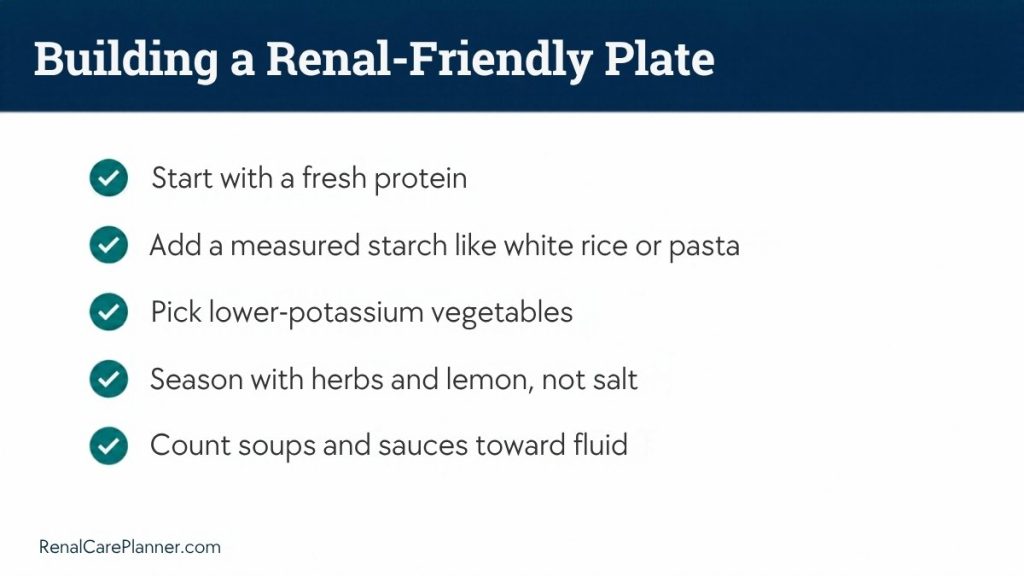
Free tools: Soups and sauces count toward fluid, so log them in the Fluid Log, and track meals alongside your treatment notes in the 90-Day Dialysis Planner.
Related Renal Care Planner resources
- What Can You Eat on Hemodialysis?
- How to Manage Fluid Restriction on Dialysis
- Best Kidney-Friendly Cookbooks for a Renal Diet
Sources
- National Institute of Diabetes and Digestive and Kidney Diseases: Eating & Nutrition for Hemodialysis
- National Kidney Foundation: Hemodialysis and Your Diet
General education only. Renal Care Planner does not provide individualized medical or nutrition advice. Dialysis nutrition needs vary by lab results, treatment schedule, urine output, medications, diabetes status, and other health conditions. Review major diet changes with your renal dietitian or care team.