

Three trips a week to the dialysis clinic adds up fast. If your IHSS provider is the one driving you, it is natural to wonder whether those hours count. The short answer is: sometimes the travel does, the time in the waiting room usually does not, and a ride by itself is not enough to qualify. Here is how California’s IHSS medical accompaniment rules actually work for dialysis.
Quick answer
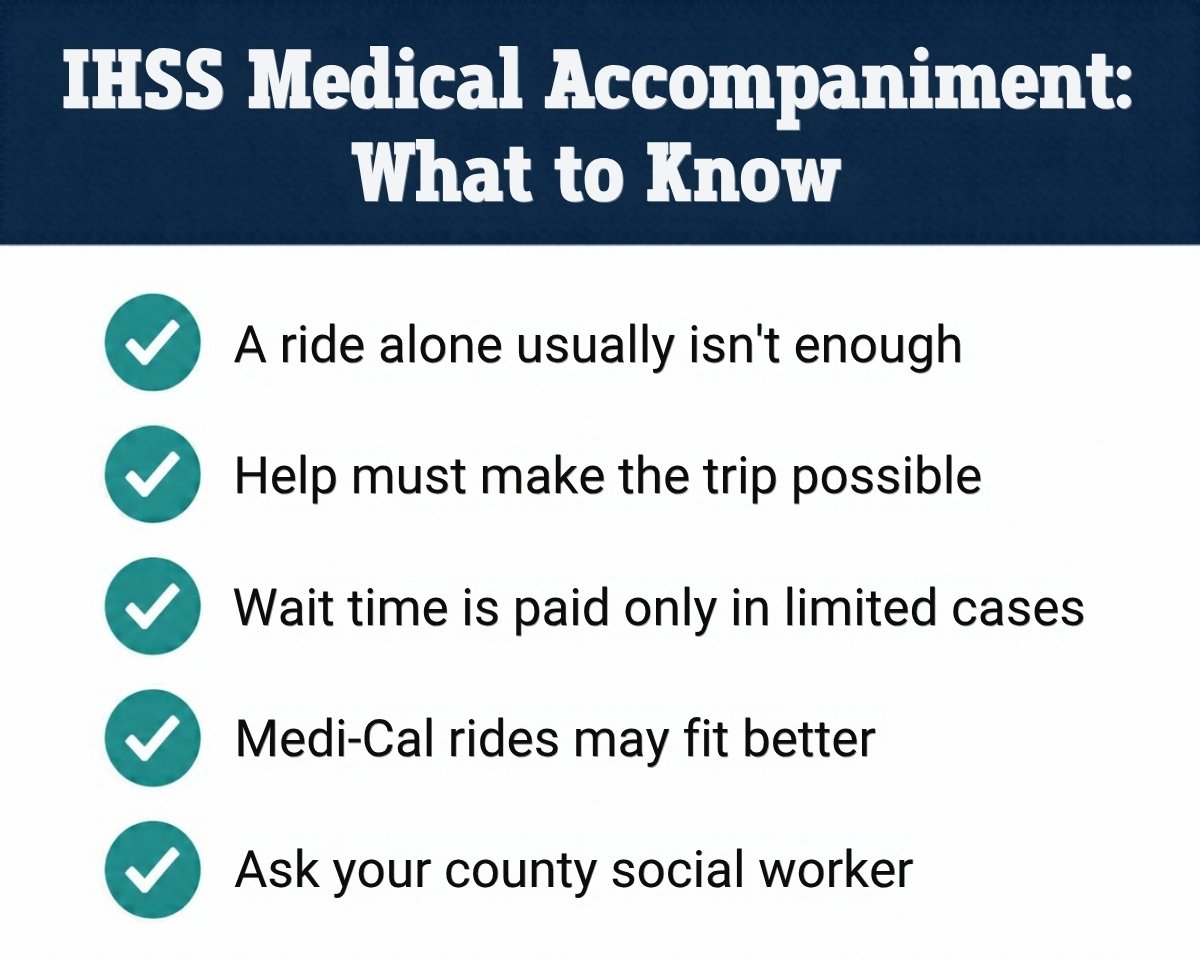
IHSS medical accompaniment is not authorized just because you need a ride. It can be authorized when you need help with another IHSS task on the way to or at the appointment, or when your condition keeps you from making the trip alone and your provider’s presence is what makes the trip possible. When it is authorized, the travel time to and from the clinic can be paid. Time spent waiting during a dialysis treatment is generally not paid if the provider is free to leave and come back at a set time, which is how California’s own guidance describes a typical treatment of two or more hours.
What IHSS medical accompaniment is
Medical accompaniment is one of the services IHSS can authorize. It covers the help a person needs to get to and attend health care appointments, including dialysis. If you are new to the program, start with our guide to IHSS for Dialysis Patients in California.
The key idea is that accompaniment pays for help, not for transportation. California’s own accompaniment form states that it is not intended simply to get someone to a medical facility.
When accompaniment to dialysis can be authorized
Based on guidance the California Department of Social Services has issued to counties, accompaniment can be authorized in two main situations:
- You need help with another IHSS task during the trip or at the clinic. For example, you need physical help getting in and out of the car, walking from the parking lot to the clinic door, or using the restroom.
- Your condition keeps you from making the trip on your own, and having your provider with you is what makes the trip possible. For example, you get confused in unfamiliar places, or you are too unsteady to travel alone.
If you can safely get to dialysis by yourself and only lack a car, accompaniment usually will not be authorized. In that case, transportation benefits are the better path. See Dialysis Transportation in California.
Travel time: what can be paid
When accompaniment is authorized, the county can authorize time for the trip from your home to the clinic and back. With three treatments a week, that travel time can be a meaningful number of hours each month, so it is worth making sure the county has your real schedule and a realistic travel time, including traffic and parking.
Wait time during dialysis: why it usually is not paid
This is the part that surprises most families. California’s guidance separates two kinds of waiting:
- “Engaged to wait” (can be paid): The provider has to stay because they may be needed at any moment, such as a short appointment where they must be ready for the trip home.
- “Waiting to be engaged” (not paid): The provider knows how long the appointment will last, is told in advance they may leave, and can use that time for their own activities before coming back at a set time.
CDSS uses a dialysis treatment scheduled for two or more hours as its example of “waiting to be engaged.” During treatment, the dialysis staff are caring for you, the end time is roughly known, and the provider can leave and return. Under that guidance, the hours in the chair are generally not IHSS-paid time.
There is an exception worth knowing. Later CDSS guidance says wait time should be authorized when the recipient continues to need the provider’s help to remain at the appointment. If your situation truly requires your provider to stay with you during treatment, explain exactly why, and ask your county social worker how it applies to you.
If this sounds familiar
Your son drives you to dialysis Monday, Wednesday, and Friday, sits in the lobby for four hours, and drives you home. He has assumed all of that is IHSS time. Under California’s guidance, the drive may count if accompaniment is authorized, but the four hours in the lobby probably will not. Knowing that now can prevent timesheet problems later.
If you use Medi-Cal transportation
Some people ride to dialysis with Medi-Cal transportation but still need hands-on help during the trip or at the clinic. According to CDSS guidance summarized by Legal Services of Northern California, accompaniment can still be authorized in that case, but only for the time it takes to travel between your home and the appointment.
If your ride is the problem, our guide to what to do if your ride to dialysis falls through walks through backup options.
The accompaniment form (SOC 2274)
Counties use a form called the IHSS Accompaniment to Medical Appointment form (SOC 2274). Your medical provider fills in the type of appointment, how often it happens, and how long it typically lasts.
- Ask your county social worker whether they need this form for your case.
- Ask the dialysis clinic’s front desk or social worker who completes it. Your nephrologist may sign it.
- Make sure the form shows the actual schedule: three treatments a week, the usual chair time, and the arrival time the clinic expects.
- Keep a copy for your records.
What to tell the county social worker
Be specific about what your provider actually does on dialysis days. A general “she takes me to dialysis” leaves out the details the county needs.
“After treatment I’m too dizzy to walk to the car alone. My daughter holds my arm from the clinic door to the car and helps me in. At home she helps me up the steps and into a chair.”
That description shows hands-on help during travel, which is the kind of need accompaniment is designed for.
A note for spouses
Spouses have their own IHSS rules. In general, a spouse is expected to provide some help without pay. However, a spouse who left full-time work because no other suitable provider was available may be paid for medical accompaniment in some situations. Ask your county how the “able and available spouse” rules apply to your household.
Questions to ask your county IHSS social worker
- Based on my needs, do I qualify for medical accompaniment to dialysis?
- Do you need a SOC 2274 from my dialysis clinic or nephrologist?
- How much travel time per trip are you authorizing, and how did you calculate it?
- Is any wait time authorized, and if not, what would I need to show if my provider has to stay?
- If I use Medi-Cal transportation, can my provider still be paid for helping during the trip?
- How should my provider record accompaniment time on the timesheet?
Keep your schedule and contacts handy
Your county will want your real treatment schedule. Keep it, along with your clinic and IHSS contacts, in one place with Renal Care Planner’s free tools.
My Dialysis Care Team & Contacts →
Questions for My Dialysis Team →
Want it all in one place? The 90-Day Dialysis Planner keeps treatment notes, patterns, and questions together for three months.
Where to go next
- You are still applying: IHSS for Dialysis Patients in California
- You mainly need a ride: Dialysis Transportation in California
- A family member is doing most of the driving: What Caregivers Should Know: Supporting Someone New to Dialysis
- You need help navigating the county: What Does a Dialysis Social Worker Do?
The main thing to remember
IHSS pays for help, not for rides. If you need hands-on help getting to and from dialysis, medical accompaniment may cover the travel time. The hours your provider spends waiting while you are on the machine are usually not paid, because staff are caring for you and your provider can leave and return. Describe your real needs clearly and ask the county to explain exactly what it authorized.
Sources
- CDSS All-County Letter 14-82: Medical Accompaniment and Wait Time
- CDSS: IHSS Accompaniment to Medical Appointment Form (SOC 2274)
- Legal Services of Northern California: IHSS Time for Medical Accompaniment (ACL 17-42 summary)
- Legal Services of Northern California: IHSS Medical Accompaniment (ACL 20-35 summary)
- Legal Services of Northern California: IHSS Able and Available Spouse Rule
- California Department of Social Services: IHSS Program
General education only. This guide summarizes California IHSS medical accompaniment guidance as of October 2026. Counties apply these rules case by case, and policies can change. Renal Care Planner is not affiliated with the California Department of Social Services and does not provide legal or benefits advice. For a decision about your hours, contact your county IHSS office, your dialysis social worker, or a legal aid organization.