
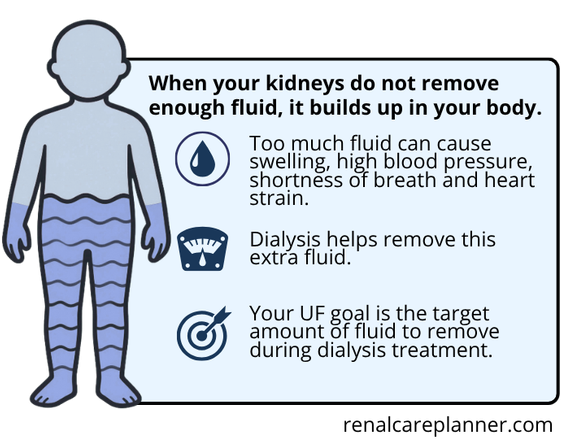
If you have looked at the dialysis machine or heard staff discuss “UF,” the number can be difficult to interpret. In hemodialysis, UF stands for ultrafiltration—the part of treatment that removes fluid from your blood. The UF goal is the total amount of fluid the treatment is programmed to remove for that session.
Quick answer
The UF goal is the amount of fluid the dialysis machine is programmed to remove during that treatment. It is set by the care team based on the treatment prescription and the patient’s current assessment—not by the machine itself.

What ultrafiltration does
Healthy kidneys remove extra water throughout the day by making urine. When the kidneys can no longer remove enough fluid, some of that work has to happen during dialysis.
During hemodialysis, pressure across the dialyzer membrane moves water from the blood into the dialysis fluid. That process is called ultrafiltration. It happens during the same treatment that removes many waste products, but fluid removal and waste removal are not the same process.
For a broader walkthrough of the treatment, see What Happens During Hemodialysis?
What the UF goal represents
The UF goal is usually displayed as a volume, often in milliliters. It tells the machine how much fluid to remove over the scheduled treatment.
The number displayed on the machine is not always identical to the change you see on the scale. Fluid may be given or taken in during treatment. Examples can include saline, medications mixed with fluid, the saline used when treatment ends, and anything you drink while in the chair. The exact label and what is included in the displayed goal can also vary by machine and facility.
If you want to understand the number on your screen, ask your dialysis team what that facility includes in the UF goal.
How the care team determines the goal
There is no single scale calculation that independently determines the correct UF goal. The difference between your pre-treatment weight and your current target weight helps inform the plan, but the care team still has to consider the prescription and how you are doing that day.
Information that may be considered includes:
- Your pre-treatment weight and recent post-treatment weights
- Your prescribed or clinically assessed target weight
- Your blood pressure, breathing, swelling, and current symptoms
- How much urine you still make, if any
- How you tolerated fluid removal during recent treatments
- The prescribed treatment time and any orders that affect fluid removal
- Fluid expected to be given or consumed during treatment
- Any provider orders and facility-specific safety protocols that apply to fluid removal
Your target weight can also change over time as your fluid status, appetite, body composition, health, or treatment plan changes. Read What Is Dry Weight in Dialysis? for a closer explanation.
UF goal and UF rate are not the same
These two terms are related, but they answer different questions:
- UF goal: the total fluid volume the treatment is set to remove.
- UF rate: how quickly that fluid is scheduled to be removed during the treatment.
The same total amount of fluid can be removed at different rates depending on the treatment time. A shorter treatment leaves less time for fluid removal. This is one reason the care team looks at the entire prescription instead of judging the UF goal by itself.
There is no universal “good” UF number to compare with another patient. Body size, treatment time, remaining kidney function, target weight, medical history, and tolerance are different from person to person.
Why the UF goal may change during treatment
The UF goal entered at the beginning of treatment is a planned target. It may be adjusted if the clinical picture changes. The care team may reassess fluid removal when:
- Blood pressure drops or changes significantly
- Cramping, nausea, dizziness, headache, or unusual weakness develops
- Saline or another fluid has to be given
- The treatment is interrupted or ends earlier than planned
- A nurse or prescribing clinician changes the plan after reassessment
An adjustment does not automatically mean something went wrong. It means the treatment plan is being matched to the information available during that session.
Symptoms to report right away
Tell the dialysis staff promptly if you develop:
- Muscle cramps
- Dizziness, lightheadedness, or a feeling that you may pass out
- Nausea or vomiting
- A sudden headache, vision change, or unusual weakness
- Chest pain, trouble breathing, or any new severe symptom
Do not wait until the end of treatment to mention symptoms. Their timing can help the team understand what was happening when they began.
What the UF goal cannot tell you by itself
A UF goal is useful treatment information, but it is not a complete measurement of your fluid status. By itself, the number cannot confirm that:
- Your target weight is exactly right
- All planned fluid will be removed
- A higher or lower goal is better
- Your symptoms are caused only by fluid removal
Weights, blood pressure, symptoms, physical findings, treatment history, and the prescription have to be considered together.
Questions you can ask at the chair
- What is my UF goal today?
- What does the number on this machine include?
- How is today’s goal connected to my target weight and prescription?
- Did the goal change during treatment? If so, why?
- Which symptoms should I report immediately?
- Who should I talk with if my recent treatments have been difficult to tolerate?
You can use the free Questions for My Dialysis Team worksheet to keep these questions together.
Track patterns without changing the treatment yourself
If a treatment feels different from usual, write down the date, your pre- and post-treatment weights, the UF goal you were shown, when symptoms started, and what the care team changed. A short record can make recurring patterns easier to discuss.
Do not change your target weight, fluid intake, medications, treatment time, or machine settings on your own. Those decisions belong with your dialysis care team.
Key points
- UF means ultrafiltration, the process dialysis uses to remove fluid.
- The UF goal is the total fluid volume programmed for removal during the session.
- Pre-treatment weight helps inform the goal but does not determine it by itself.
- UF goal and UF rate are related but different.
- The care team may adjust fluid removal when symptoms, blood pressure, treatment time, or other clinical information changes.
General education only
Renal Care Planner provides general educational information and planning resources. It does not provide individualized medical advice, diagnosis, or treatment recommendations. Questions about fluid removal, target weight, symptoms, and your dialysis prescription should be discussed with your dialysis care team.
How the UF goal fits into treatment
A fluid-removal goal is part of the treatment plan entered for that session.
The machine removes fluid gradually while showing the programmed goal and progress.
Staff monitor how treatment is going and use the full clinical picture when deciding whether a change is appropriate.
What your dialysis team can see and assess
The weights and treatment plan being used for that session.
How your blood pressure and how you feel change during treatment.
The programmed UF goal, treatment time and fluid-removal progress shown on the machine.
A useful question: What UF goal was set today, and how did it compare with the fluid removed?