
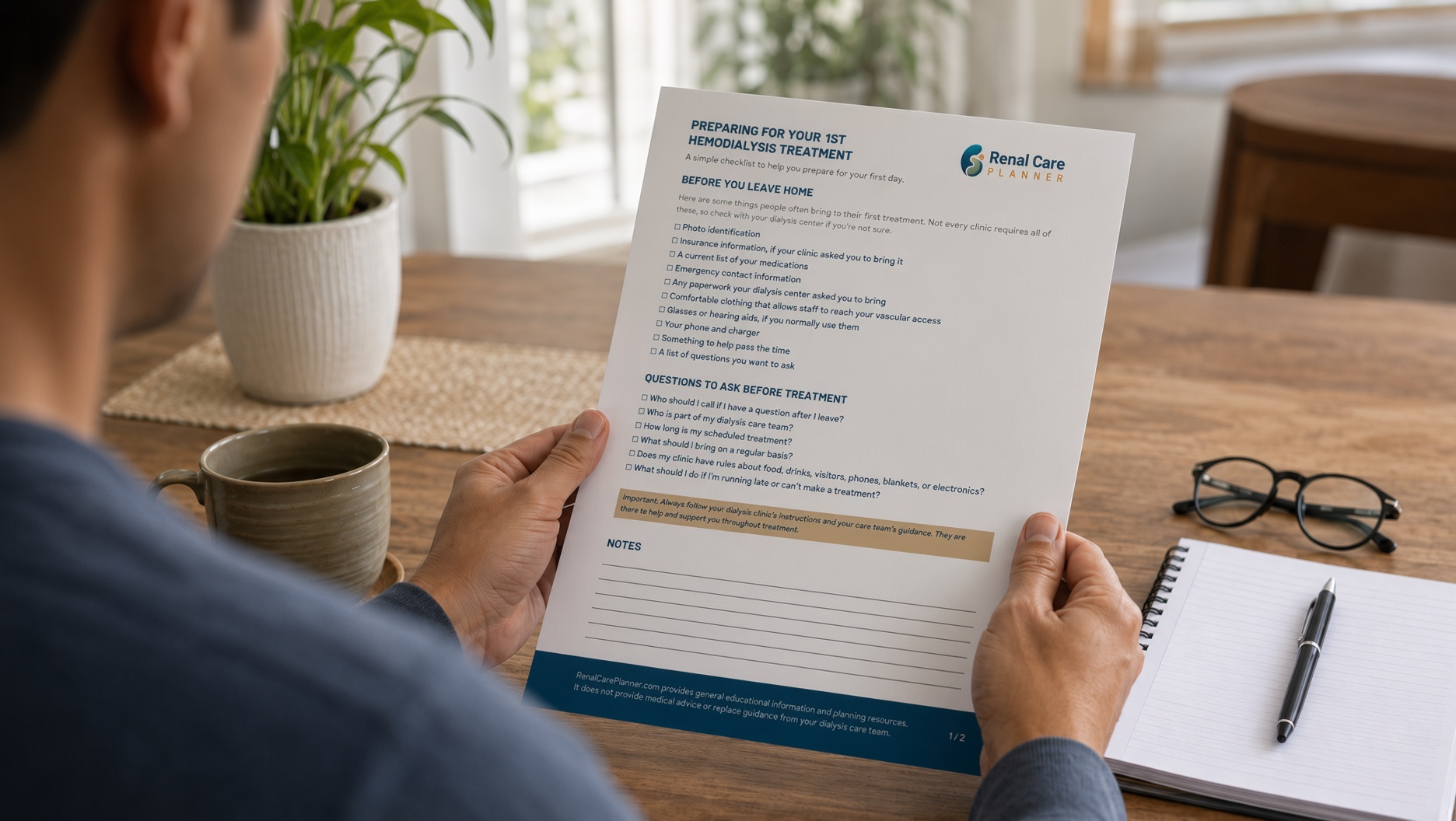
Dialysis days become easier when the routine starts before you walk into the clinic. A few simple checks the night before and again in the morning can reduce forgotten medications, missing paperwork, transportation problems, and last-minute scrambling without turning preparation into another complicated medical task.
Quick answer
The night before dialysis, confirm transportation, gather what you plan to bring, review any questions or instructions, and make sure you know which medicines your own care team wants taken before treatment. In the morning, follow your usual food and fluid plan, check your access as instructed, dress for easy access, and arrive with enough time for your clinic’s check-in routine.
The night before: confirm the logistics first
Transportation problems can turn an otherwise routine dialysis day into a missed or shortened treatment. If someone is driving you, confirm the plan. If you use a transportation service, verify the pickup window and have the phone number available in case the ride is late.
If you think you may not be able to make your treatment, contact your dialysis center as soon as possible rather than simply skipping the session. Missing dialysis can allow extra fluid, potassium, acid, and waste to build up between treatments. See What Happens If You Miss a Dialysis Treatment? for more context.
Pack the things you actually use
You do not need a large bag of special dialysis products. Most treatment-day bags are built around ordinary comfort, entertainment, charging, and organization.
- Identification or paperwork your clinic has asked you to bring
- An up-to-date medication list if your team wants one
- Phone, headphones, book, tablet, or another way to pass the time
- Charging cable or portable power bank if allowed
- A simple blanket or layer if you tend to get cold
- Your written questions or treatment notes
For specific organization and comfort ideas, use What to Bring to Dialysis. Your clinic’s rules always come first.
Set out clothing that makes your access easy to reach
If you have an arm fistula or graft, choose sleeves that are short, loose, or easy to move above the access. If you have a chest or neck catheter, a front-opening shirt or layer can make the dressing easier for staff to reach without requiring you to pull clothing around the catheter site.
See the Dialysis Clothing Guide for access-specific clothing ideas.
Review medication instructions—do not guess
Some medicines are taken on their usual schedule around dialysis, while others may have special timing instructions. The correct plan depends on the medication and your medical history. Do not skip, delay, double, or move a dose because of a general internet rule about dialysis.
If you are unsure whether a medicine should be taken before treatment, check the instructions your clinician gave you or contact the team managing the medication. Our Medication Timing and Dialysis guide explains why timing questions come up and what to ask.
Write down questions while they are still fresh
The night before treatment is often when people remember the question they meant to ask at the last session. Put it somewhere you will actually see it the next day.
- Can we review the symptom I had after my last treatment?
- Can you explain the number or term staff mentioned last time?
- Is there anything different you want me to do with my access?
- Can we review the timing of one of my medicines?
- Who should I contact if transportation makes me late?
See Questions to Ask Your Dialysis Care Team for a longer list.
Morning of treatment: follow your own food and fluid plan
There is no universal dialysis-morning meal that is right for everyone. Food and fluid instructions depend on your labs, urine output, medicines, other health conditions, treatment schedule, and your center’s policies. Follow the plan your dialysis dietitian and care team have given you rather than restricting or adding food and fluid based on a generic checklist.
If you are still learning how eating changes after starting dialysis, see What Can You Eat on Hemodialysis? and How to Manage Fluid Restriction on Dialysis.
Check your access the way your team taught you
If you have a fistula or graft, know what it normally looks and feels like. NIDDK advises patients to check for the vibration caused by blood flow and to notify the dialysis center if that vibration is absent. CDC encourages patients to report changes such as redness, swelling, or drainage.
If you have a catheter, keep the dressing protected according to your center’s instructions and tell staff if it is wet, dirty, loose, painful, red, swollen, or has drainage.
For fistula and graft care, use How to Protect Your Fistula or Graft.
Think about how you feel before you leave home
You do not need to perform a home medical assessment before every treatment, but it is useful to notice whether anything feels meaningfully different from your usual baseline. Tell your dialysis team about symptoms or changes when you arrive instead of assuming dialysis will automatically fix them.
If you think you are experiencing a medical emergency, call 911 or seek emergency medical care rather than relying on a routine dialysis appointment.
Leave enough time for the full clinic visit
The time on the dialysis machine is only part of the visit. Check-in, weighing, vital signs, access preparation, setup, connection, disconnection, bleeding control for needle sites, post-treatment checks, and transportation can all add time around the prescribed treatment itself.
If the time commitment still feels confusing, see Why Does Dialysis Take So Long?.
A simple night-before checklist
- Confirm transportation and pickup time.
- Pack the treatment-day items you actually use.
- Set out access-friendly clothing.
- Review your own medication instructions.
- Write down one to three questions for the care team.
- Charge the phone or devices you plan to bring.
A simple morning-of checklist
- Follow your prescribed food, fluid, and medication plan.
- Check your access as your team has instructed.
- Notice any symptoms or changes you need to report.
- Bring your questions and any requested paperwork.
- Leave enough time for your clinic’s full check-in process.
Prefer a printable checklist?
Use Renal Care Planner’s free planning tools for treatment-day packing, questions, notes, and other repeatable routines.
The main thing to remember
Preparing for dialysis should make the day simpler, not give you another treatment plan to manage on your own. Confirm the logistics, bring what you use, follow the instructions your care team has already given you, and arrive ready to report anything that changed since your last session.
Sources
- National Institute of Diabetes and Digestive and Kidney Diseases: Hemodialysis
- National Kidney Foundation: Hemodialysis — How It Works, Types, and What to Expect
- Centers for Disease Control and Prevention: Infections and Patients on Dialysis
General education only. This checklist provides general treatment-day organization ideas. It does not provide individualized instructions for medications, food, fluid, dialysis settings, or vascular access care. Follow the instructions from your own dialysis care team.