

In-center dialysis lands in the middle of the work week, three times a week, every week. If you want to keep your job, or keep caring for someone who is on dialysis without losing yours, the federal Family and Medical Leave Act (FMLA) can be one of the most useful tools you have. The key is a feature many people don’t know about: intermittent leave.
Quick answer
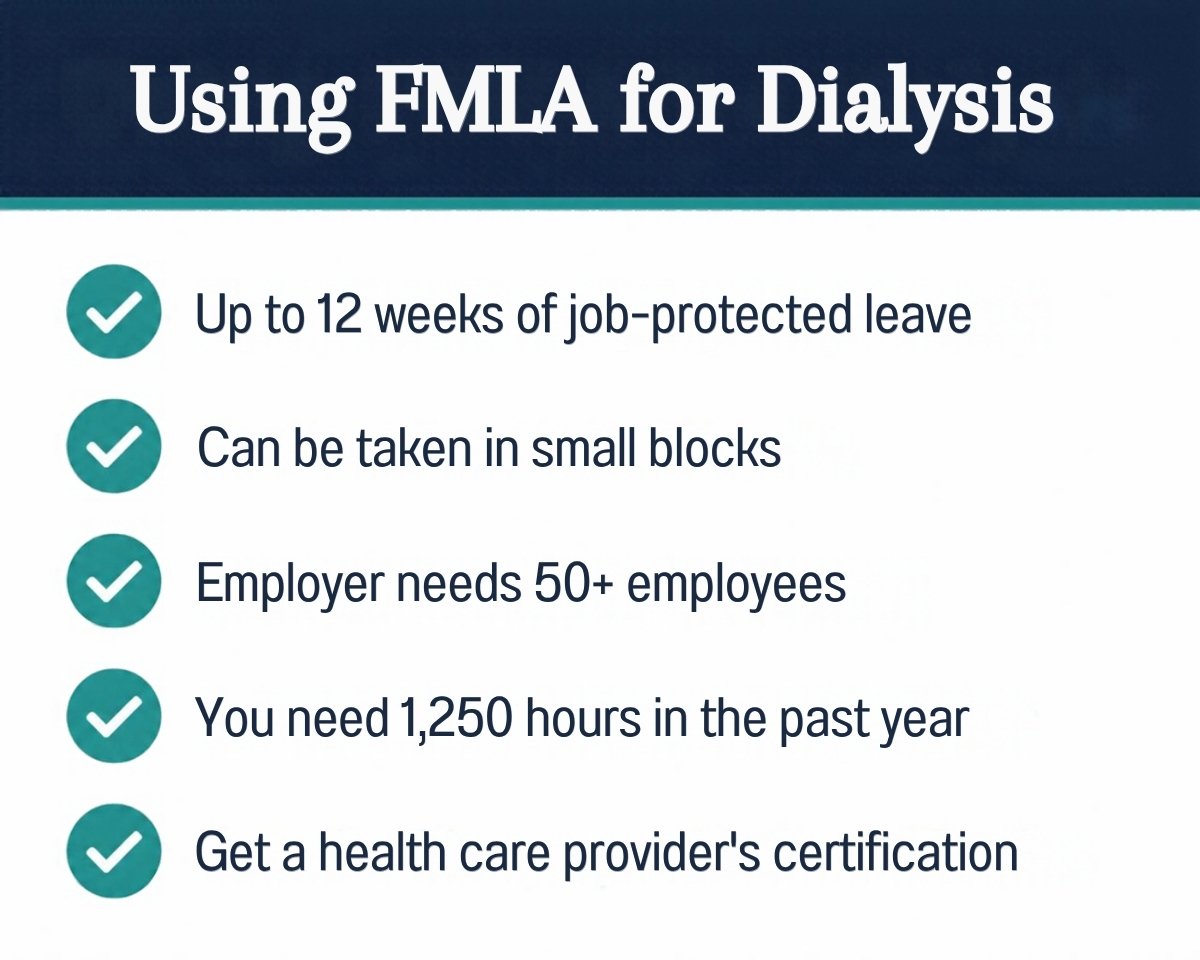
If you work for a covered employer and meet the eligibility rules, FMLA provides up to 12 workweeks of unpaid, job-protected leave in a 12-month period, either for your own serious health condition or to care for a spouse, child, or parent. Dialysis is specifically listed in federal rules as an example of continuing treatment for a chronic condition. When it is medically necessary, leave can be taken intermittently, in blocks as short as an hour or more, which can fit a dialysis schedule. Your employer can ask for certification from your health care provider. In California, the state’s CFRA law provides similar protections and covers more employers.
Who qualifies for FMLA
According to the U.S. Department of Labor, FMLA covers:
- Employers: private employers with 50 or more employees in 20 or more workweeks in the current or previous year, plus public agencies and schools regardless of size.
- Employees who have: worked for the employer at least 12 months, worked at least 1,250 hours in the 12 months before leave, and work at a location with 50 or more employees within 75 miles.
FMLA leave can be used for your own serious health condition or to care for a spouse, child, or parent with one. It does not cover caring for in-laws.
Why dialysis counts
FMLA defines a “serious health condition” to include conditions that require continuing treatment by a health care provider. The federal regulations name kidney disease treated with dialysis as an example of a condition requiring multiple treatments. In practice, that makes dialysis one of the clearer cases for FMLA eligibility.
How intermittent leave works
Most people picture FMLA as weeks off in a row. But the law also allows intermittent or reduced-schedule leave when it is medically necessary. The Department of Labor’s rules describe intermittent leave in periods from an hour or more up to several weeks. For dialysis, that might look like:
- Leaving early on Monday, Wednesday, and Friday for an afternoon chair time
- Taking a reduced schedule, such as working three full days and two short days
- Taking occasional days off after a hard treatment or for an access procedure
- For a family caregiver, leaving to drive a parent to and from treatment
For planned treatments, you are expected to make a reasonable effort to schedule them in a way that does not unduly disrupt your employer’s operations, as long as your care team agrees.
Doing the math: does 12 weeks cover a year of dialysis?
Twelve workweeks for a full-time, 40-hour employee is about 480 hours of leave in a 12-month period. FMLA counts only the time you actually take off. If dialysis costs you about 9 work hours a week (three 3-hour blocks), that adds up to about 468 hours over a full year, which is close to the limit. If it costs more, you may run out before the year ends.
That is why many people combine FMLA with other options:
- Asking for an evening or nocturnal dialysis shift so treatment falls outside work hours
- Shifting work hours, for example starting earlier on treatment days
- Requesting a reasonable accommodation under disability law, which is separate from FMLA
- Considering a home dialysis option with more schedule flexibility
Your exact numbers depend on your schedule. Work them out with HR.
What your employer can ask for
- Medical certification. Your employer can require a certification from a health care provider supporting the need for leave. The Department of Labor publishes optional certification forms for an employee’s own condition and for a family member’s.
- Enough detail for intermittent leave. The certification should explain the treatment schedule, such as three treatments a week, and why intermittent leave is medically necessary.
- Notice. For foreseeable leave like a regular dialysis schedule, give your employer as much notice as you reasonably can, and follow your employer’s usual call-in procedures.
Ask your nephrologist’s office or the dialysis social worker who completes FMLA paperwork at your clinic.
Pay and benefits during FMLA
FMLA leave is unpaid, though your employer may let you use, or require you to use, paid sick or vacation time at the same time. Your employer must keep your group health coverage in place on the same terms as if you were working. That matters a lot during the first 30 months of kidney-failure Medicare. See Medicare and Dialysis: The 30-Month Coordination Period.
California: the CFRA
California has its own job-protected leave law, the California Family Rights Act (CFRA). It provides leave to care for yourself or a family member with a serious health condition and generally reaches more employers than FMLA, including many smaller businesses. California’s Paid Family Leave program is separate. It can replace part of your wages while you care for a family member, but on its own it does not protect your job. The California Civil Rights Department publishes a quick reference guide on CFRA.
If this sounds familiar
You’ve been quietly leaving early three days a week and working late to make up for it, hoping nobody notices. It works, until a new manager starts asking questions. Putting intermittent leave on paper now doesn’t announce anything you’re not ready to share. It just protects the schedule you’re already keeping.
How to ask
- Talk to HR, not just your manager. HR handles leave paperwork and can tell you whether you qualify.
- Bring your treatment schedule. Days, times, and how long you usually need afterward.
- Get the certification form and take it to your clinic.
- Agree on how you’ll record leave hours, so they are tracked accurately.
- Keep copies of everything you submit and receive.
You do not have to share more medical detail with coworkers than you want to. See Working While on Dialysis for help with those conversations.
Questions to ask HR
- Am I eligible for FMLA, CFRA, or both?
- Can I take intermittent leave or a reduced schedule for regular dialysis treatments?
- Which certification form do you need, and when is it due?
- Do I have to use paid time off at the same time?
- How will my health insurance continue during leave?
- If I use up my leave, what accommodation options might be available?
Have your treatment details ready
HR and your clinic will both ask about your schedule and care team. Keep that information organized in one place.
My Dialysis Care Team & Contacts →
Questions for My Dialysis Team →
Want it all in one place? The 90-Day Dialysis Planner keeps treatment notes, patterns, and questions together for three months.
Where to go next
- You want to keep working: Working While on Dialysis
- You’re weighing work against disability: Working vs. Disability When You Start Dialysis
- You’re caring for a parent on dialysis: Sandwich-Generation Caregiving
- You’re sorting out insurance: Medicare and Dialysis
The main thing to remember
Dialysis clearly fits FMLA’s definition of a serious health condition, and intermittent leave was designed for schedules like this. Check your eligibility, get the certification done, and track your hours, because 12 weeks can run short over a full year. In California, CFRA may cover you even if FMLA doesn’t.
Sources
- U.S. Department of Labor: Family and Medical Leave Act
- U.S. Department of Labor: FMLA Frequently Asked Questions
- 29 CFR Part 825: Definitions, Including Serious Health Condition
- California Civil Rights Department: Family, Medical and Pregnancy Leave
General education only. This guide summarizes federal FMLA rules and California leave laws in general terms as of October 2026. Eligibility and rights depend on your employer, work history, and situation. Renal Care Planner does not provide legal or employment advice. For your specific situation, talk with your HR department, the U.S. Department of Labor, the California Civil Rights Department, or an employment attorney.