

Kidney failure is one of the few reasons someone under 65 can get Medicare. But the timing is confusing, especially if you already have insurance through a job. People hear about a “waiting period,” a “coordination period,” and Part B, and are not sure what to sign up for or when. This guide lays out the basics in plain language so you know which questions to ask.
Quick answer
If you are on in-center dialysis and eligible, Medicare based on kidney failure usually starts on the first day of the fourth month of treatment. You sign up through Social Security. If you also have employer or union group health coverage, that plan pays first and Medicare pays second for 30 months. This is called the coordination period. After 30 months, Medicare pays first. Whether and when to enroll in Part B depends on your group plan, so talk it through with your social worker and insurer before deciding.
Who qualifies for Medicare because of kidney failure
According to Medicare.gov, there is no age requirement. You can qualify if you have permanent kidney failure that requires regular dialysis or a transplant, and:
- You, your spouse, or a dependent child has enough work credits under Social Security, the Railroad Retirement Board, or as a government employee, or
- You already receive, or are eligible for, Social Security or Railroad Retirement benefits.
When coverage starts
- In-center dialysis: Usually the first day of the fourth month of dialysis. For example, if treatment starts in July, coverage usually starts October 1. This waiting period runs even if you haven’t signed up yet.
- Home dialysis training: Coverage can start as early as the first month if you begin a Medicare-certified home training program within the first three months and meet other conditions.
- Kidney transplant: Coverage can start the month you are admitted for the transplant, or earlier in some cases.
Medicare.gov also notes that if you don’t sign up right away, coverage can be backdated up to 12 months before the month you apply. If you have an employer plan, it may cover those first three months.
How to sign up
Unlike Medicare at 65, kidney-failure Medicare is not automatic. You apply for Part A and Part B through Social Security, either at a local office or by calling 1-800-772-1213. Your dialysis social worker usually helps with the forms, and the clinic completes a medical evidence form that confirms your treatment.
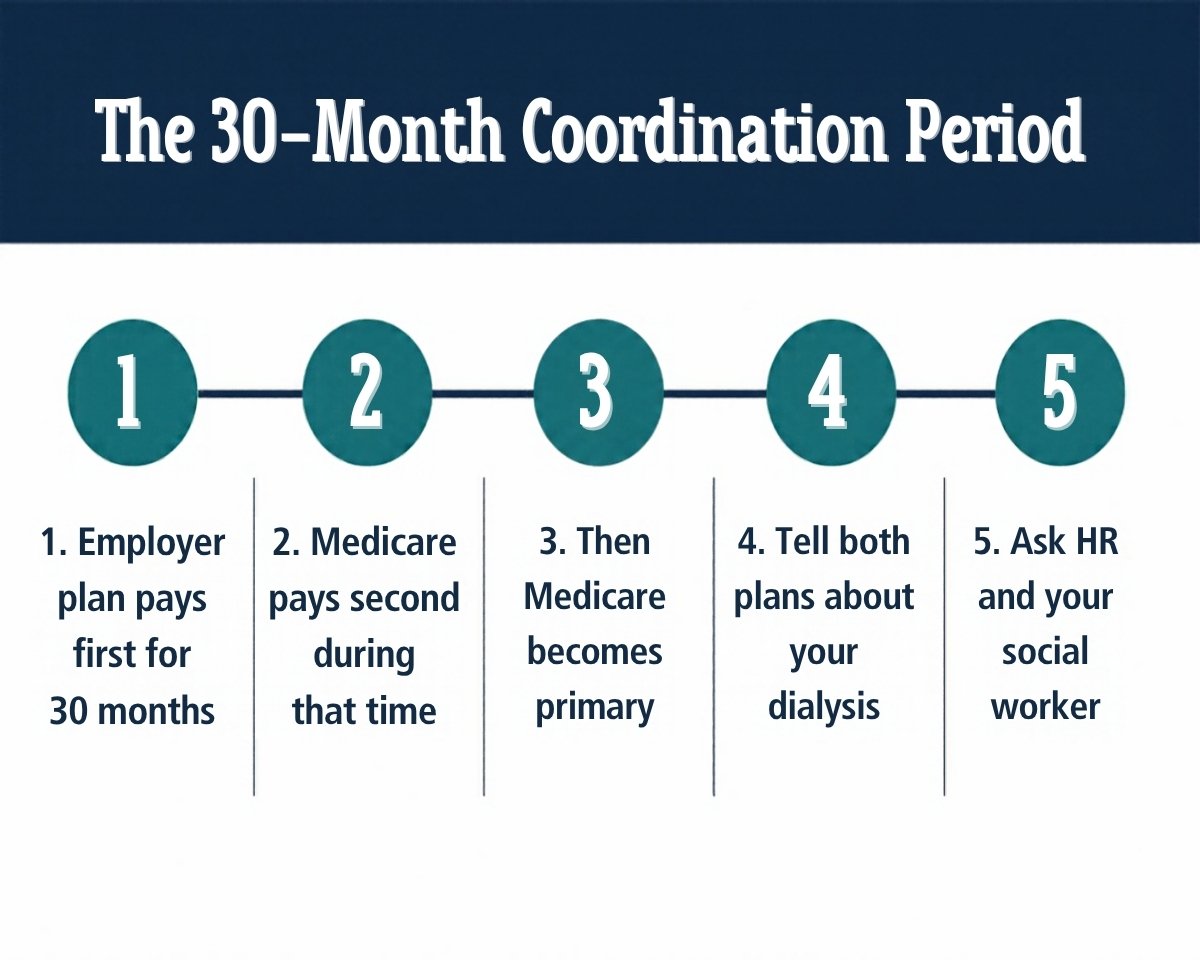
The 30-month coordination period
If you have health coverage through your own or your spouse’s current or former employer or union, the rules change for a while:
- For 30 months, your group health plan pays first and Medicare pays second.
- The 30 months start when you first become eligible for Medicare based on kidney failure, usually the fourth month of dialysis, even if you haven’t enrolled yet.
- After 30 months, Medicare becomes the primary payer and the group plan pays second.
- A new 30-month period can start if you qualify for kidney-failure Medicare again later.
Medicare.gov advises telling your providers about your group coverage so bills go to the right place first.
If this sounds familiar
You started dialysis in March, you still work full time, and your employer plan is paying. Someone at the clinic said you “should sign up for Medicare,” but your plan looks fine. You are not wrong to pause. The real question is how your plan works with Medicare over the next 30 months, and what happens to your coverage if you cut hours or leave the job. That is the conversation to have before you decide.
Thinking about Part B during the coordination period
Medicare.gov says you don’t have to enroll in Part B right away if you have group coverage, and lists factors to weigh:
- If your group plan has deductibles or coinsurance, Medicare as a second payer may help cover those costs.
- If your group plan already covers most costs, you might choose to wait until the 30 months are nearly over. Medicare.gov says your Part B premium won’t be higher because you waited, but you should enroll promptly if your group benefits shrink or end.
- If you are planning a transplant, Medicare’s rules for covering anti-rejection drugs depend on having Medicare at the time of transplant, so ask about this specifically.
- If you have COBRA when you enroll in Medicare, COBRA will probably end.
Some consumer guides also caution that enrolling in Part A alone and delaying Part B can affect when you are allowed to add Part B later. Because these choices interact with your specific plan, get advice before you enroll in only one part.
Medicare Advantage and Part D
- Medicare Advantage: People with kidney failure can choose Original Medicare or a Medicare Advantage plan. If you choose Advantage, check that your dialysis clinic, nephrologist, and any transplant center are in the plan’s network.
- Prescription drugs: Part B covers most dialysis-related drugs given at the clinic. Other prescriptions are covered under Part D, and you have a 7-month window around your eligibility month to enroll.
When kidney-failure Medicare ends
- 12 months after the month you stop dialysis, or
- 36 months after the month of a successful kidney transplant
Coverage can continue without a break if you restart dialysis or get another transplant within those windows.
Questions to ask your social worker, HR, or insurer
- When does my Medicare eligibility start, and has my clinic completed its part of the paperwork?
- When does my 30-month coordination period begin and end?
- How does my group plan work with Medicare as the second payer?
- Should I enroll in Part B now or later, given my plan’s deductibles and coinsurance?
- If I reduce my hours or leave my job, what happens to my coverage?
- If I’m considering a transplant, how does Medicare timing affect anti-rejection drug coverage?
Bring your questions to the right person
Insurance questions often get answered in pieces by different people. Keep your questions and contacts in one place.
Questions for My Dialysis Team →
My Dialysis Care Team & Contacts →
Want it all in one place? The 90-Day Dialysis Planner keeps treatment notes, patterns, and questions together for three months.
Where to go next
- You’re deciding whether to keep working: Working vs. Disability When You Start Dialysis
- You want to stay on the job: Working While on Dialysis
- You need help with the forms: What Does a Dialysis Social Worker Do?
The main thing to remember
For in-center dialysis, Medicare usually starts in the fourth month. If you have employer coverage, your group plan pays first for 30 months, and that clock starts whether or not you have enrolled. The Part B decision depends on your plan, your job plans, and whether a transplant is likely, so get personal advice before you choose.
Sources
- Medicare.gov: End-Stage Renal Disease (ESRD)
- CMS: Dialysis and Kidney Transplant Resources
- Social Security Administration: End Stage Renal Disease (ESRD) (Publication EN-64-107)
- Medicare Rights Center (Medicare Interactive): Medicare and ESRD
General education only. This guide summarizes Medicare rules for people with kidney failure as of October 2026. Medicare rules, premiums, and plan details change, and your situation depends on your work history and other coverage. Renal Care Planner does not provide insurance, legal, or financial advice. Confirm decisions with Social Security, Medicare (1-800-MEDICARE), your plan, your employer’s benefits office, or a State Health Insurance Assistance Program (in California, HICAP).