

A lot of work advice for dialysis patients assumes a desk job with flexible hours. Many people on dialysis lift boxes, stock shelves, work construction, cook in hot kitchens, care for patients, or drive for a living. Those jobs bring specific challenges: protecting your access arm, working in heat with a fluid limit, and making rigid shift schedules fit around three treatments a week. Here is how people make it work.
Quick answer
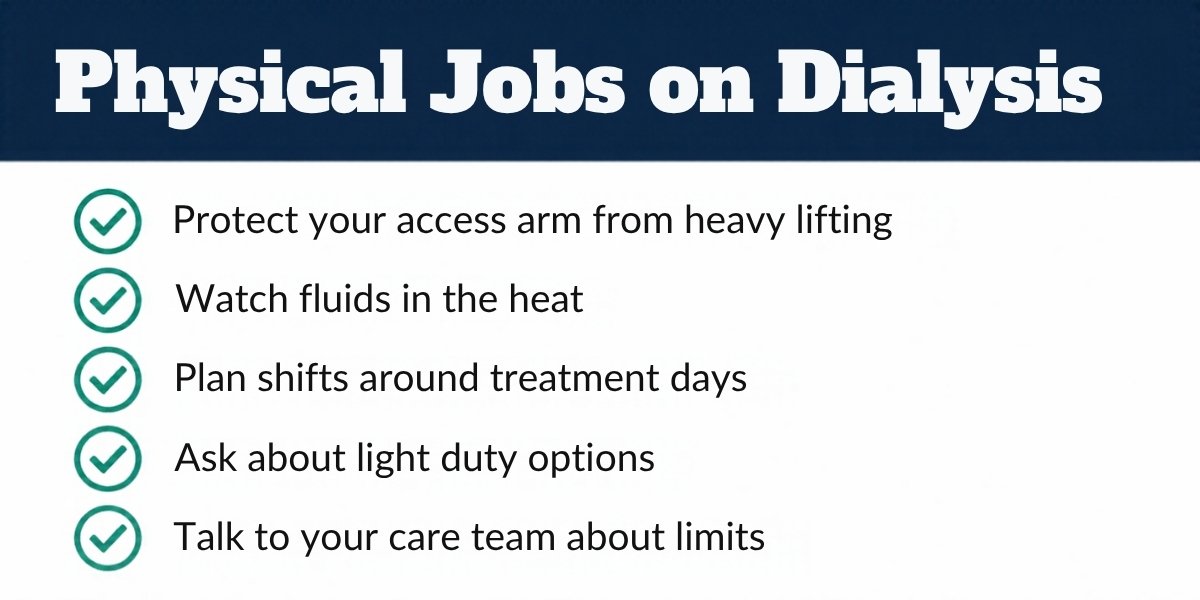
Many people on dialysis keep physical jobs. The keys are: get clear limits from your care team about lifting and pressure on your access arm, match your shifts to your chair time instead of the other way around, plan for heat and fluid with your dietitian, and ask your employer for specific accommodations, like a modified schedule or task changes. Commercial drivers have additional federal medical requirements, so talk with a certified medical examiner early.
Protecting your access at work
Your fistula, graft, or catheter is your lifeline for dialysis, and physical work can put it at risk. Ask your care team for specific guidance for your job, including:
- How much you can lift, and whether limits differ for your access arm
- Whether tight sleeves, gloves, tool belts, or straps press on your access
- How to protect a catheter from sweat, dirt, and pulling
- What signs of an access problem mean you should stop and call the clinic
For everyday basics, see How to Protect Your Fistula or Graft.
Matching shifts to your chair time
Shift-based jobs can actually be easier to plan around than office jobs, because the schedule is already broken into blocks. Common approaches:
- Early shift plus afternoon treatment: Work 5 a.m. to 1 p.m., then go to dialysis.
- Treatment in the morning, work later: Works if you usually feel okay a few hours after treatment.
- Longer shifts on non-treatment days: Fewer, longer shifts on Tuesday, Thursday, and the weekend.
- Evening or nocturnal dialysis: Frees your days. See Evening and Nocturnal Dialysis Shifts.
Avoid stacking a heavy shift right after a long treatment until you know how you feel afterward.
Heat, sweat and your fluid limit
Hot jobs are tricky when you have a fluid limit. You may sweat more than someone at a desk, but drinking freely between treatments can lead to fluid buildup. This is a conversation for your renal dietitian and nephrologist, because the right approach depends on your situation. Ask how heat, sweating, and long shifts should affect your fluid plan, and whether cooling breaks or shaded work could help. See How to Manage Fluid Restriction on Dialysis.
Energy after treatment
Many people feel tired or washed out for several hours after standard hemodialysis, according to the National Institute of Diabetes and Digestive and Kidney Diseases. On physical jobs, that matters for safety: ladders, machinery, and lifting are riskier when you’re lightheaded. If you often feel unsteady after treatment, don’t schedule high-risk tasks right after, and tell your care team.
If this sounds familiar
You’ve worked in a warehouse for 15 years and you’re good at it. Since starting dialysis, the afternoons after treatment are rough and you’ve been nervous using the pallet jack. That’s a reasonable worry, not weakness. Ask your supervisor about moving heavy tasks to your non-treatment days, and ask your care team what limits make sense for you.
If you drive for a living
Commercial drivers who need a federal medical certificate must be examined by a certified medical examiner, and kidney failure is one of the conditions the Federal Motor Carrier Safety Administration has studied for driver safety. Whether you can keep a commercial license depends on the examiner’s assessment of your health. Talk with your nephrologist and a certified medical examiner early, before your next certification is due. For everyday driving after treatment, see Can You Drive Yourself Home After Dialysis?
Accommodations you can ask for
Under disability laws, employers must consider reasonable accommodations unless they cause undue hardship. According to the EEOC, examples include modified schedules and leave for treatment. On physical jobs, people often ask for:
- A set schedule that works around treatment days
- Lighter duty or different tasks right after treatment
- Help with heavy lifts, or lifting equipment
- Short rest breaks
- Uniform changes that avoid pressure on the access arm
For how to have the conversation, see How to Tell Your Boss You’re Starting Dialysis. For protected time off, see FMLA and Dialysis.
Questions to ask your care team
- What lifting or pressure limits should I follow at work for my access?
- How should heat and sweating at work affect my fluid plan?
- Is there a better time of day for my treatment, given my job?
- What signs at work mean I should stop and call the clinic?
- Can you help with paperwork for work restrictions or accommodations?
Get your work questions answered
Write down your job tasks and questions before your next care team conversation so you get specific answers.
Questions for My Dialysis Team →
Want it all in one place? The 90-Day Dialysis Planner keeps treatment notes, patterns, and questions together for three months.
Where to go next
- The bigger picture on work: Working While on Dialysis
- Your access arm: How to Protect Your Fistula or Graft
- Your chair time is the problem: Evening and Nocturnal Dialysis Shifts
- Fatigue after treatment: Adjusting to Dialysis: The First 90 Days
The main thing to remember
Physical and shift-based jobs can work on dialysis with the right plan. Get specific limits from your care team, build your shifts around your chair time, plan for heat with your dietitian, and ask for concrete accommodations. Protect your access the way you’d protect any tool your job depends on.
Sources
- NIDDK: Hemodialysis
- EEOC: Reasonable Accommodation and Undue Hardship Under the ADA
- FMCSA: Chronic Kidney Failure and Commercial Motor Vehicle Driver Safety
- American Kidney Fund: Returning to Work
General education only. This guide offers general information about working while on dialysis. Lifting limits, fluid plans, and fitness to drive are individual medical decisions. Renal Care Planner does not provide medical, legal, or employment advice. Follow your care team’s instructions and talk with your employer, HR, or a certified medical examiner about your specific situation.