

For many people, the hardest part of in-center dialysis is not the needles or the machine. It is the clock. A Monday-Wednesday-Friday chair time in the middle of the day can make a regular job, college classes, or school pick-ups feel impossible. Evening and overnight (nocturnal) shifts exist, but they are less common and not every clinic offers them. Here is what to know and how to ask.
Quick answer
Some clinics offer a late-afternoon or evening shift, and a smaller number offer in-center nocturnal dialysis: about 7 to 9 hours, three nights a week, while you sleep at the clinic. Home Dialysis Central estimates only about 5% of U.S. dialysis clinics offer in-center nocturnal treatment. Research has linked access to evening shifts with higher employment among dialysis patients. Ask your social worker about shift availability, waitlists, and nearby clinics that offer later times, and ask your nephrologist whether a longer nocturnal treatment would be appropriate for you.
Why your shift time matters so much
Research on dialysis and employment has found that working was more common at facilities that offered a shift starting at 5 p.m. or later, home dialysis training, or more frequent treatment. A chair time is not just a scheduling detail. For many people, it decides whether they can keep a job or stay in school.
Evening shifts
Some clinics run a last shift that starts in the late afternoon or early evening. It is still a standard-length treatment, about four hours. That can work for people who get off work around 3 or 4 p.m., or for students with morning classes. Many clinics have only a few late chairs, and they fill quickly, so waitlists are common.
In-center nocturnal dialysis
According to Home Dialysis Central:
- Treatments happen three nights a week, about 7 to 9 hours each, plus travel.
- Most programs run from around 8 p.m. to 4 a.m. A few start in the mid-afternoon.
- Staff run the treatment, so you don’t need a home care partner.
- You get roughly twice as much dialysis time as a standard in-center schedule.
A 2017 review of studies summarized on the American Journal of Kidney Diseases blog found lower phosphorus, better hemoglobin, and improvements in heart muscle thickness in some studies of nocturnal patients, with no outcome found to be worse. The studies were small and mostly observational, so results are not certain.
Pros and cons of nocturnal treatment
Possible advantages:
- Your days are free for work, school, or family
- A slower, longer treatment may feel gentler, with fewer cramps and blood pressure drops for some people
- Some people find their diet and fluid limits loosen, though this is up to the care team
Possible downsides:
- Sleeping in a clinic chair is not for everyone
- Late-night and early-morning travel can be hard if you can’t drive
- Few clinics offer it, which makes traveling harder
- You still have needles, and there is still a two-day gap each week
If this sounds familiar
You work 8 to 5, your clinic gave you an 11 a.m. chair, and you have used up most of your leave in three months. Before you decide between your job and your treatment, ask two things: is there an evening or nocturnal program within driving distance, and can you get on its waitlist now?
Who nocturnal dialysis may fit
- People who want to keep a daytime job or go to school
- People who feel wiped out after standard treatments, if their nephrologist agrees longer sessions may help
- People who want more dialysis but don’t have a home partner or space for home treatment
- People who sleep reasonably well away from home
How to ask for a different shift
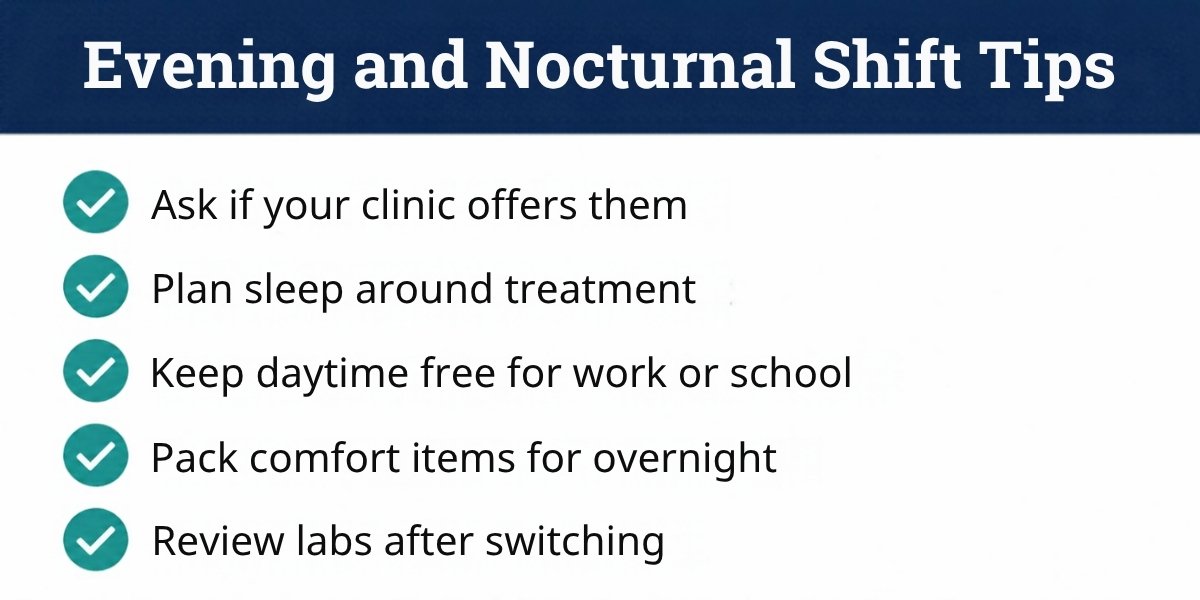
- Tell the social worker why. “I need a later shift to keep my job” is a stronger request than “I’d prefer later.”
- Ask about waitlists. Get on the list even if the wait is long. Ask how it works and how often it moves.
- Ask about nearby clinics. A different clinic in the same company, or another provider, may have later chairs or a nocturnal program.
- Talk to your nephrologist about whether nocturnal treatment is medically right for you.
- Put it in writing and follow up if nothing changes.
Home Dialysis Central notes that clinics sometimes start a nocturnal program when enough patients ask. Your request counts.
If no late shift is available
- Ask your employer for schedule flexibility. See Working While on Dialysis.
- Use job-protected leave. See FMLA and Dialysis.
- Ask about home dialysis. Home peritoneal dialysis or home hemodialysis can be scheduled around work. It’s a bigger change, but worth a conversation.
Questions to ask your clinic
- What is the latest shift this clinic offers, and is there a waitlist?
- Does any nearby clinic offer evening or nocturnal dialysis?
- Would nocturnal treatment be appropriate for me medically?
- If I switch shifts or clinics, what happens to my transportation arrangements?
- Would you consider starting a nocturnal program if more patients asked?
Bring your request in writing
Write down your work or school schedule and your questions before you meet with the social worker, so nothing gets missed.
Where to go next
- Keep it all in one place: The 90-Day Dialysis Planner
- You want to keep working: Working While on Dialysis
- You need protected time off: FMLA and Dialysis
- You’re wondering why treatments take so long: How Long Does Dialysis Take?
- You need help making the request: What Does a Dialysis Social Worker Do?
The main thing to remember
Your chair time shapes the rest of your week. Evening and nocturnal shifts are uncommon, but they exist, and asking early, explaining why, and getting on a waitlist gives you the best chance of finding one. If a later shift isn’t possible, schedule flexibility, protected leave, and home dialysis are worth exploring.
Sources
- Home Dialysis Central: Nocturnal In-Center Hemodialysis
- AJKD Blog: In-Center Nocturnal Dialysis, What Do We Know?
- Healio: Unemployment Among Dialysis Patients Is a Complex Issue
- American Kidney Fund: Returning to Work
General education only. This guide offers general information about dialysis shift options. Availability varies by clinic and region, and whether a longer or nocturnal treatment is right for you is a medical decision. Renal Care Planner does not prescribe treatment. Talk with your nephrologist and dialysis team about your options.