

Your dialysis schedule is set when you start, but your life keeps moving. A new job, a different class schedule, a change in childcare, or a ride that’s only available in the afternoon can make your chair time stop working. Clinics juggle a lot of patients in a limited number of chairs, so changes aren’t always instant. But asking the right way, and early, makes a real difference.
Quick answer
For a permanent change, tell the charge nurse or clinic manager and the social worker what you need and why, and ask to be put on the waitlist for that shift. Put the request in writing and follow up. For a one-time change, ask as far ahead as you can. Same-day changes are hardest. Don’t skip or shorten a treatment because of a scheduling conflict without talking to the clinic first. If your clinic can’t accommodate you, ask about other clinics nearby or about evening, nocturnal, or home options.
Why schedule changes take time
Most in-center clinics run set shifts, often a Monday-Wednesday-Friday pattern and a Tuesday-Thursday-Saturday pattern, each with morning, midday, and afternoon chairs. Every chair, machine, and staff member is assigned. A new opening usually comes up only when another patient moves, transfers, or stops treatment. That’s why the most popular slots, early mornings and late afternoons, often have waitlists.
Asking for a permanent change
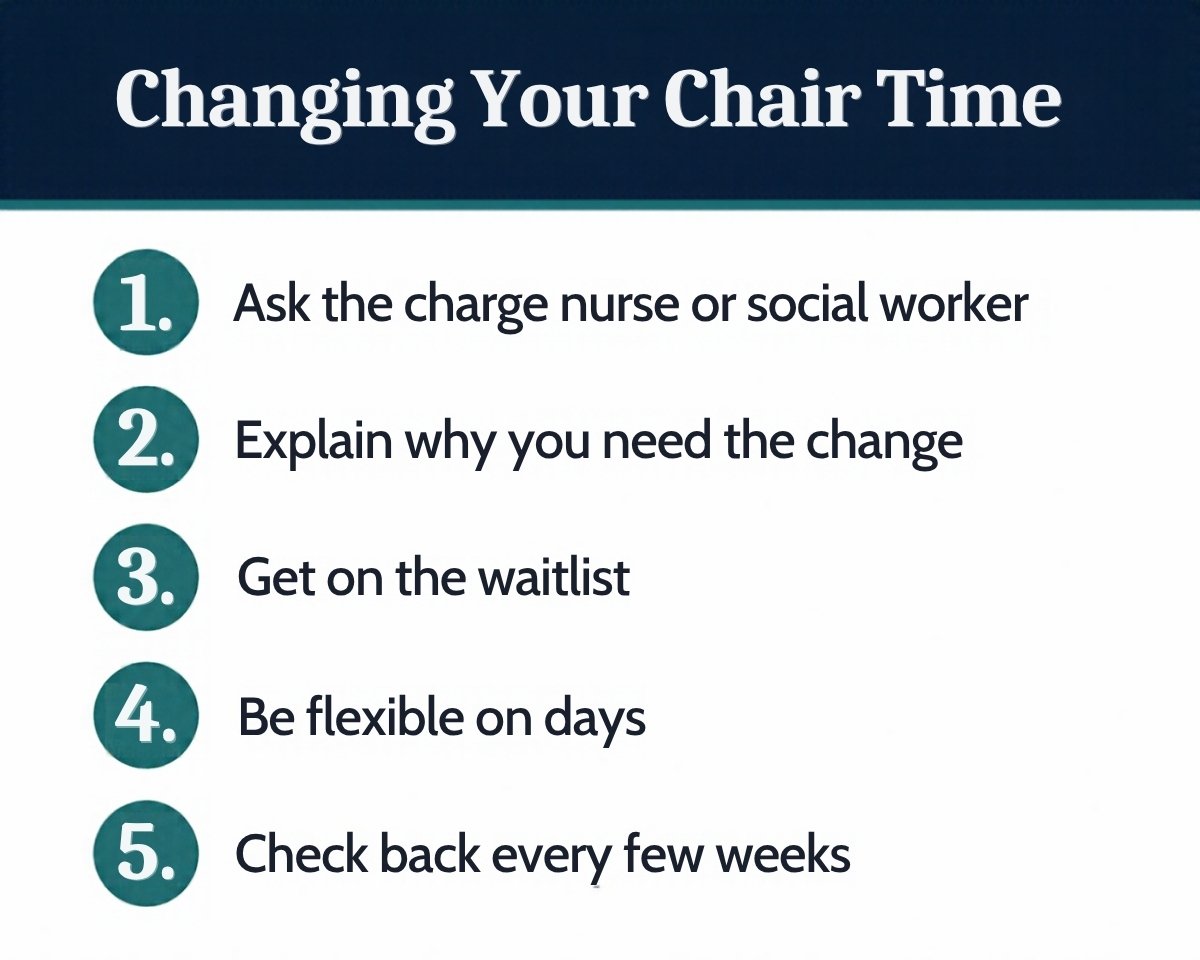
- Know exactly what you need. “Any shift starting after 2 p.m. on Tuesday, Thursday, Saturday” is easier to match than “something later.”
- Explain why. Keeping a job, staying in school, or caring for a child helps staff understand the priority.
- Tell the right people. Usually the charge nurse or clinic manager handles scheduling. The social worker can help advocate.
- Ask to be put on the waitlist, and ask how it works.
- Put it in writing and keep a copy.
- Follow up every couple of weeks, politely.
- Be flexible where you can. If you can take one of two options, say so.
One-time changes
- Ask early. A week or more ahead gives the clinic a chance to swap you with another patient.
- Offer options. “Could I come in the day before or the morning shift instead?”
- Never just skip. If you can’t make your time, call the clinic. See What Happens If You Miss a Dialysis Treatment?
- Don’t ask to cut treatment short to fit in plans without talking to the care team. Shortened treatments matter.
Holidays and clinic closures
Many clinics adjust schedules around major holidays, which can shift your treatment days for that week. Ask well ahead what the holiday schedule will be so you can plan rides, work, and family events. For travel during the holidays, see Can Dialysis Patients Travel?
If this sounds familiar
You just got hired for a job that starts next month, but your current chair time is in the middle of the workday. Ask the clinic manager and social worker today, in writing, for a specific later shift, and explain it’s about keeping the job. Then ask your new employer about a temporary schedule adjustment while you wait. Working both sides at once usually gets there faster.
If the answer is no (for now)
- Ask about other clinics nearby that may have the shift you need
- Ask about evening or nocturnal options. See Evening and Nocturnal Dialysis Shifts.
- Ask about home dialysis, which can be scheduled around your life
- Ask your employer or school for flexibility in the meantime. See How to Tell Your Boss You’re Starting Dialysis.
- If you believe you’re being treated unfairly, see How to Raise a Problem at Your Dialysis Clinic.
Questions to ask
- Who handles scheduling changes here?
- Is there a waitlist for the shift I need, and where am I on it?
- Do other clinics nearby have openings at that time?
- What is the holiday schedule this year?
- How far ahead should I ask for a one-time change?
Bring your request ready to go
Write down the exact shift you need and why before you talk to the clinic.
Where to go next
- Keep it all in one place: The 90-Day Dialysis Planner
- Later shifts: Evening and Nocturnal Dialysis Shifts
- Work: Working While on Dialysis
- School: Going to College While on Hemodialysis
- Help from the clinic: What Does a Dialysis Social Worker Do?
The main thing to remember
Chair time changes depend on openings, so ask early, be specific, explain why, and get on the waitlist in writing. Never skip or cut a treatment to solve a scheduling problem without talking to your clinic first.
Sources
General education only. Scheduling practices vary by clinic. Renal Care Planner does not provide medical advice. Talk with your clinic before changing, shortening, or missing any treatment.