

Dialysis doesn’t have to end your education. People start college, finish degrees, earn trade certificates, and go back to school while on dialysis every year. It takes more planning than it does for most students, mainly because three treatment days a week collide with a class schedule that wasn’t built around them. Here is how to set yourself up to succeed.
Quick answer
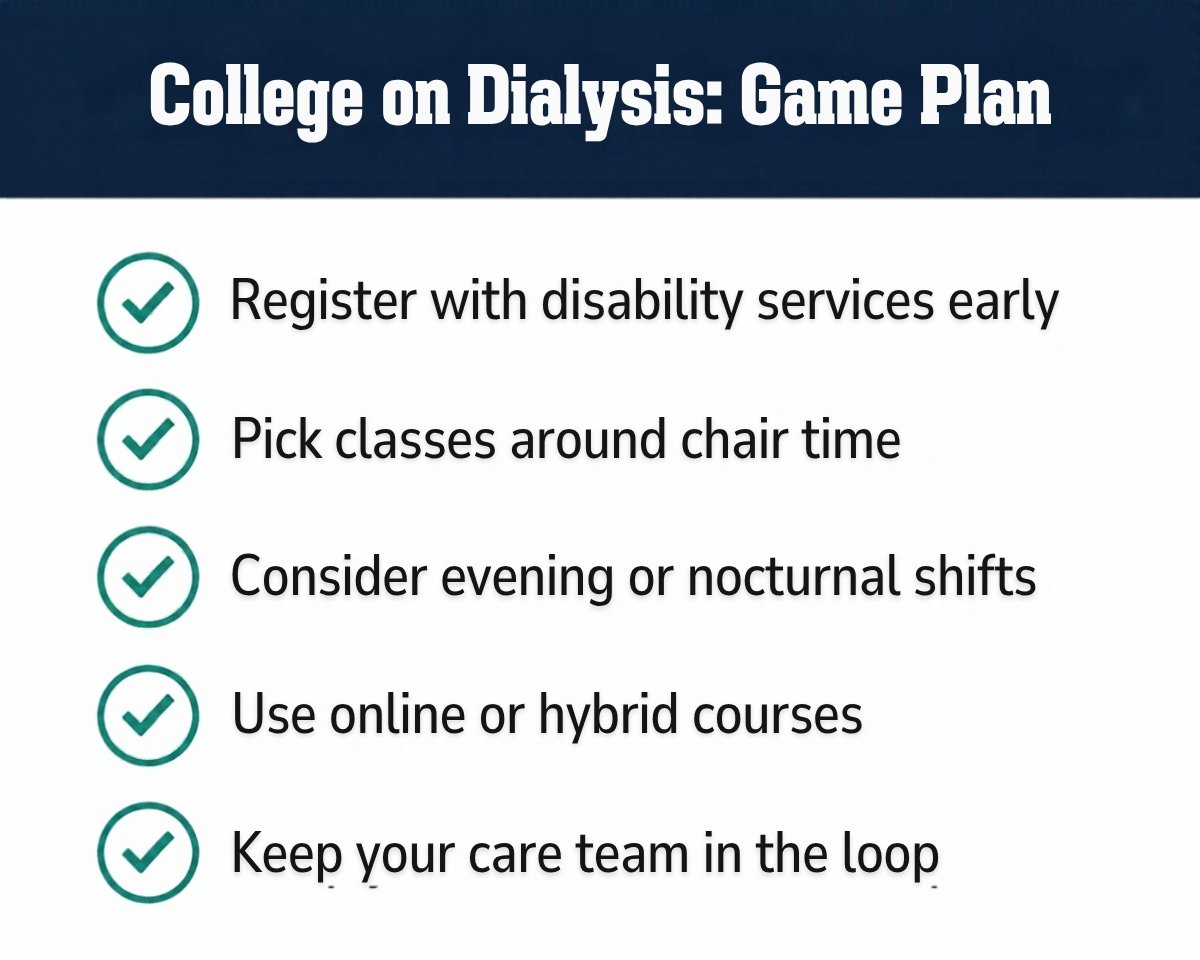
Build your class schedule around your chair time, not the other way around, and look for online, hybrid, or evening sections. Register with your school’s disability services office early. In college, you have to request accommodations yourself, and a high school IEP or 504 plan does not carry over automatically. Common accommodations include attendance flexibility, extra time on assignments, and help making up missed work. Ask your dialysis social worker about vocational rehabilitation and other ways to help pay for school.
Build your schedule around chair time
- Start with dialysis. Block out treatment times, travel, and a buffer for recovery before you choose classes.
- Use your off days. Tuesday-Thursday classes pair well with a Monday-Wednesday-Friday dialysis schedule, and the reverse.
- Look for flexible formats. Online, hybrid, and evening sections give you more room to move.
- Ask about a later shift. An evening or nocturnal chair can free your days. See Evening and Nocturnal Dialysis Shifts.
- Consider a lighter load at first. You can add classes once you know how you feel through a semester.
Home dialysis can offer more flexibility for some students. DaVita notes that people on home dialysis can schedule treatments around school activities. It’s worth a conversation with your nephrologist.
Getting accommodations: how it works in college
College is different from high school. According to St. Jude’s guide for teens and young adults:
- Accommodations go through the campus disability services office.
- It is the student’s responsibility, not the parent’s, to register and request them.
- The school will ask for documentation of your condition and how it affects your schoolwork.
- A high school IEP or 504 plan doesn’t carry over automatically, though it may help as documentation.
- Request accommodations as early as possible, since some take time to arrange.
Professors generally learn about accommodations through the official process, not your medical details. You decide how much more to share. For a step-by-step guide, see How to Ask Your College for Dialysis Accommodations.
Accommodations dialysis students often ask about
- Flexibility on attendance for treatment days and hard recovery days
- Extra time on assignments, or a plan for making up missed work
- Rescheduling exams that fall on treatment days
- Access to lecture notes or recordings
- Priority registration so you can get sections that fit your chair time
- A reduced course load while still keeping full-time status, where your school allows it
Each school decides what is reasonable, so treat this as a starting list for your conversation.
Managing your energy
Many people feel tired for several hours after a standard treatment. Plan your study time around your own pattern:
- Use your best hours, often off-day mornings, for the hardest work
- Use chair time for lighter tasks like reading, flashcards, or recorded lectures. See Studying During Dialysis.
- Don’t schedule big exams the evening after treatment if you can avoid it
- Tell your care team if fatigue is getting in the way. It’s worth discussing.
If this sounds familiar
You started dialysis halfway through your second semester. You’ve missed eight classes, your professor is asking questions, and you’re thinking about dropping out. Before you do, go to disability services this week. Accommodations can sometimes be put in place mid-semester, and options like an incomplete or a medical withdrawal may protect your record better than walking away.
Living on campus and being away from home
- Find a clinic near campus before the term starts, and arrange the transfer with your social worker.
- Plan transportation to treatment if you don’t have a car.
- Think about food and fluid. Dining halls and dorm life can make your dialysis diet harder. Ask your renal dietitian for a plan.
- Tell at least one person nearby, such as a roommate or RA, how to reach help in an emergency.
Paying for school
- Vocational rehabilitation: State VR programs help people with disabilities get training and education for work. Ask your social worker for a referral.
- Financial aid and scholarships: Fill out the FAFSA, and look for scholarships for students with disabilities or chronic illness.
- Health insurance: Make sure your coverage, whether Medicare, Medi-Cal, a parent’s plan, or a student plan, works with your dialysis clinic.
Questions to ask
Disability services:
- What documentation do you need from my care team?
- Can I get attendance flexibility and help with missed work for treatment days?
- Is priority registration available?
Your dialysis team:
- Is there a later chair time I could get on a waitlist for?
- Can you help with a letter for disability services?
- Can the social worker refer me to vocational rehabilitation?
Keep school and treatment organized
Keep your care team contacts and questions in one place, so it’s easy to get letters and answers when school asks.
Questions for My Dialysis Team →
My Dialysis Care Team & Contacts →
Want it all in one place? The 90-Day Dialysis Planner keeps treatment notes, patterns, and questions together for three months.
Where to go next
- Asking for accommodations: How to Ask Your College for Dialysis Accommodations
- Making chair time count: Studying During Dialysis
- Finding a later shift: Evening and Nocturnal Dialysis Shifts
- Working too: Working While on Dialysis
The main thing to remember
College on dialysis is doable with planning. Build classes around your chair time, register with disability services early because nobody will do it for you, and protect your energy for the work that matters most. If things start slipping, ask for help early instead of dropping out.
Sources
- St. Jude Together: College Classroom Accommodations
- NephCure: Get College Ready, 5 Things Every High School Senior With Kidney Disease Should Know
- DaVita: Going to School on Home Dialysis
- NIDDK: Hemodialysis
General education only. This guide offers general information about attending college while on dialysis. Accommodation policies vary by school, and your treatment plan is a medical decision. Renal Care Planner does not provide legal, educational, or medical advice. Work with your school’s disability services office and your dialysis team.