

Three treatments a week adds up to roughly 12 hours in a dialysis chair. For students, and for anyone taking a class, studying for a certificate, or working remotely, that time can feel like either a frustrating loss or a useful block. Studying in the chair is possible, but it works differently than studying at a desk. One arm can’t move, the room is often cold and noisy, and your energy can dip partway through. Here is what tends to work.
Quick answer
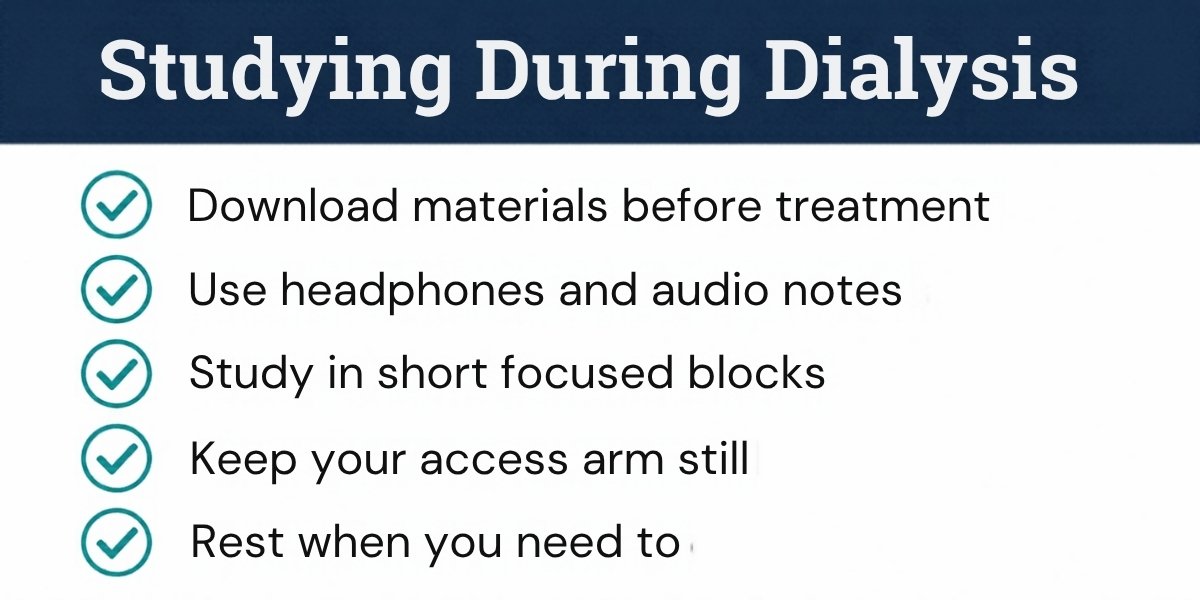
Plan for one-handed, low-setup tasks: reading, recorded lectures, flashcards, and outlining. Download everything before you arrive, since clinic Wi-Fi may be limited. Bring noise-cancelling or comfortable headphones, a stand for your tablet or phone, a charged power bank, and a blanket. Do focused work early in the session if you tend to tire later. Check your clinic’s rules on devices and calls, and keep your access arm still and visible to staff.
The one-hand reality
If you have a fistula or graft, the arm with the needles generally needs to stay still and visible during treatment. Moving it can trigger machine alarms or affect the needles. That means most of your studying will be one-handed. If you have a catheter, you may have both hands free, but you’ll still want to avoid pulling on the lines. Plan your setup around this from the start.
Tasks that fit the chair
Usually work well:
- Reading textbooks, articles, or e-books
- Watching recorded lectures or videos
- Flashcard apps and quizzing
- Listening to audiobooks or podcasts
- Outlining or voice notes using speech-to-text
- Planning your week and organizing assignments
Usually harder:
- Long typing sessions
- Live video classes with a camera and microphone
- Timed exams
- Anything that needs both hands or lots of materials
Your chairside setup
- A stand or holder for your tablet or phone, so you don’t have to hold it
- Headphones, ideally noise-cancelling, for alarms and conversations around you
- A charged power bank and a long cable, since outlets may be out of reach
- Everything downloaded ahead of time: readings, lectures, playlists
- A blanket or warm layer, since many clinics are cold. See Dialysis Clothing Guide.
- A small bag that stays organized so you can reach things one-handed. See What to Bring to Dialysis.
Timing and energy
Many people feel more alert at the start of a session and more tired toward the end. Try:
- Doing your most focused work in the first hour or two
- Switching to lighter tasks, like listening or reviewing, later on
- Giving yourself permission to rest. Some sessions won’t be study sessions, and that’s okay.
- Noticing patterns. If you consistently feel unwell during treatment, tell the staff.
If this sounds familiar
You planned to write a paper during treatment and ended up staring at the screen for three hours. That’s common. Typing one-handed in a cold, noisy room after needles go in isn’t ideal for writing. Save writing for an off day, and use chair time to read sources, watch the lecture, and outline by voice. You’ll get more done overall.
Clinic rules and courtesy
- Ask about Wi-Fi, device, and phone call rules at your clinic
- Keep sound in headphones and calls short and quiet
- Don’t cover your access with a laptop, blanket, or book. Staff need to see it.
- Pause when staff need to check on you or the machine
Questions to ask your clinic
- Is there Wi-Fi, and can I use a laptop or tablet during treatment?
- Can I get a chair near an outlet?
- Is there a quieter area or a chair away from the busiest spot?
- How still does my access arm need to be?
Pack once, reuse every treatment
Use the night-before checklist to make sure your devices, chargers, downloads, and blanket are ready to go.
Where to go next
- Pack your study kit: Treatment-Day Packing Checklist
- Keep it all in one place: The 90-Day Dialysis Planner
- College planning: Going to College While on Hemodialysis
- Accommodations: How to Ask Your College for Dialysis Accommodations
- Packing for treatment: What to Bring to Dialysis
- Staying warm: Dialysis Clothing Guide
The main thing to remember
Chair time can be good study time if you plan for how it actually works: one hand, limited Wi-Fi, a cold room, and energy that fades. Download ahead, set up hands-free, do focused work early, and save heavy writing and exams for off days.
Sources
General education only. This guide offers general tips for using time during dialysis. Clinic rules on devices and movement vary, and staff instructions about your access always come first. Renal Care Planner does not provide medical advice.