

Sometimes family and IHSS can’t cover everything. Maybe you work days, the person on dialysis lives alone, or treatment days leave them needing more help than anyone can give. Hiring a private caregiver can fill the gap. It also means letting a stranger into the home, so it’s worth doing carefully.
Quick answer
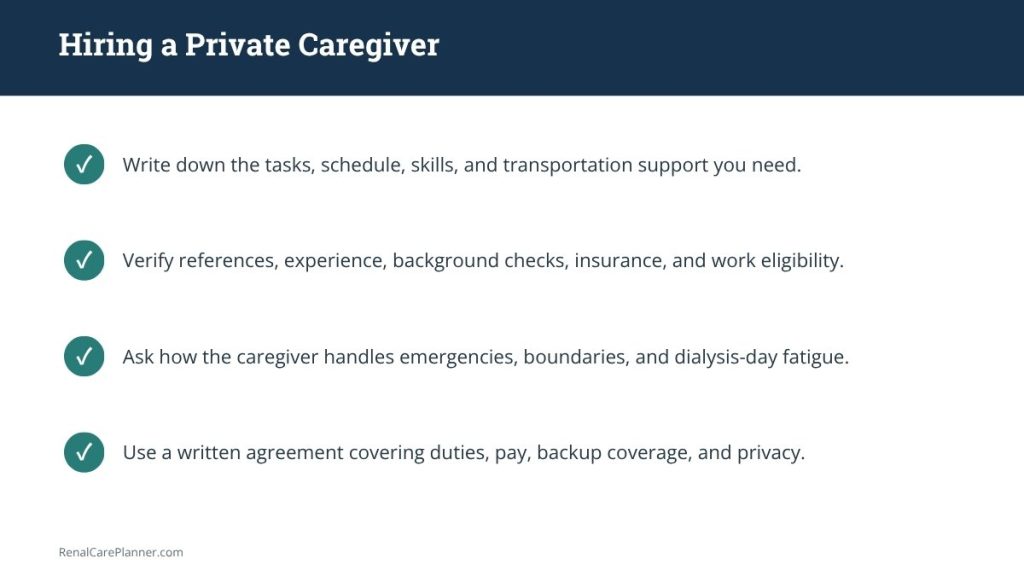
Decide whether to use a licensed home care agency or hire someone directly. In California, aides who work for licensed home care organizations must be listed on the state’s Home Care Aide Registry and pass a background check. Independent aides can register too. Ask about experience with dialysis, fluid and diet limits, and fall prevention. Check references, agree on duties and pay in writing, and if you hire directly, understand your responsibilities as a household employer.
Check other options first
Before paying out of pocket, see whether the person qualifies for IHSS (if on Medi-Cal in California), whether long-term care insurance or veterans benefits cover in-home help, and whether a Medi-Cal managed care plan offers in-home supports. See IHSS for Dialysis Patients. A private caregiver can also add to IHSS hours rather than replace them.
Agency or independent?
Licensed home care agency: handles background checks, payroll, taxes, insurance, and backup coverage when the aide is sick. Usually costs more per hour.
Independent caregiver: usually costs less and you choose the person directly, but you’re responsible for screening, scheduling, backup coverage, and possibly employer taxes.
Note that non-medical home care aides generally help with daily tasks like meals, bathing, housework, and rides. They usually can’t do medical tasks like managing a catheter dressing or giving injections. For that, ask the doctor about home health services.
California’s Home Care Aide Registry
Under California’s Home Care Services Consumer Protection Act, home care organizations must be licensed by the California Department of Social Services, and their aides must be registered, background-checked, and trained. Independent aides can choose to register. You can look up an aide’s registration status through CDSS. Ask any candidate for their registry number.
Interview questions to ask
- Have you cared for someone on dialysis before?
- Do you understand fluid limits and low-sodium, low-potassium diets?
- What would you do if they felt dizzy after treatment or their access started bleeding?
- Can you drive to and from dialysis? Do you have a clean record and insurance?
- How do you handle infection prevention and handwashing?
- What’s your availability, and what happens if you’re sick?
- Can I contact two references from past clients?

If this sounds familiar
Your mom’s caregiver is kind but keeps offering her big glasses of juice. That’s not a bad caregiver, just one nobody trained on dialysis. Give every new caregiver a one-page sheet with fluid limits, foods to avoid, access-arm rules, and who to call. Ask the dialysis dietitian to help you write it.
Put it in writing
- Duties, schedule, and pay rate
- Treatment-day routine, including rides and waiting time
- Emergency steps and phone numbers
- Rules on driving, cell phones, guests, and medications
- Notice period if either side ends the arrangement
Sharing health information with a caregiver? See HIPAA and Dialysis Caregivers.
If you hire directly
Paying a caregiver directly may make you a household employer. That can mean following minimum wage and overtime rules, withholding taxes once pay passes certain thresholds, and possibly carrying workers’ compensation. Check IRS Publication 926 and California’s EDD guidance, or talk to a tax professional. Payroll services for household employers can handle this.
Give the caregiver what they need
Print the contacts sheet and medication list for every new caregiver.
Where to go next
- Keep it all in one place: The 90-Day Dialysis Planner
- Non-family caregivers: Non-Family Caregivers and Dialysis
- Treatment days: The Treatment Day From the Caregiver’s Side
- Caregiver basics: What Caregivers Should Know
The main thing to remember
Check covered options first, choose between agency and independent, verify registry status and references, train the caregiver on dialysis basics, and put duties and pay in writing.
Sources
- California Department of Social Services: Home Care Services Bureau
- IRS Publication 926: Household Employer’s Tax Guide
- California EDD: Household Employers
General education only. This article offers general information and is not legal, tax, or medical advice. Employment and licensing rules change. Confirm current requirements with CDSS, the EDD, the IRS, or a qualified professional.