

There’s a phone number posted somewhere in your dialysis clinic that most patients never call: the number for your regional ESRD Network. Networks are part of how Medicare oversees dialysis care, and one of their jobs is helping patients when something isn’t going right. Knowing what they do, and what they don’t, can save you a lot of frustration if you ever need backup.
Quick answer
ESRD Networks are regional organizations that work under contract with the Centers for Medicare & Medicaid Services (CMS) to improve dialysis and kidney transplant care. For patients, their most useful roles are investigating grievances about a dialysis facility and helping with access-to-care problems, such as being at risk of involuntary discharge or not being able to find a clinic that will accept you. Federal rules require every dialysis clinic to post the Network’s complaint phone number where patients can see it.
What ESRD Networks are
The United States is divided into regional ESRD Networks. Each one works with the dialysis and transplant facilities in its area on quality improvement, data, emergency preparedness, and patient concerns. Networks are not part of your dialysis company, and they don’t provide treatment. Think of them as an outside organization with a role in making sure facilities meet federal requirements.
What Networks do for patients
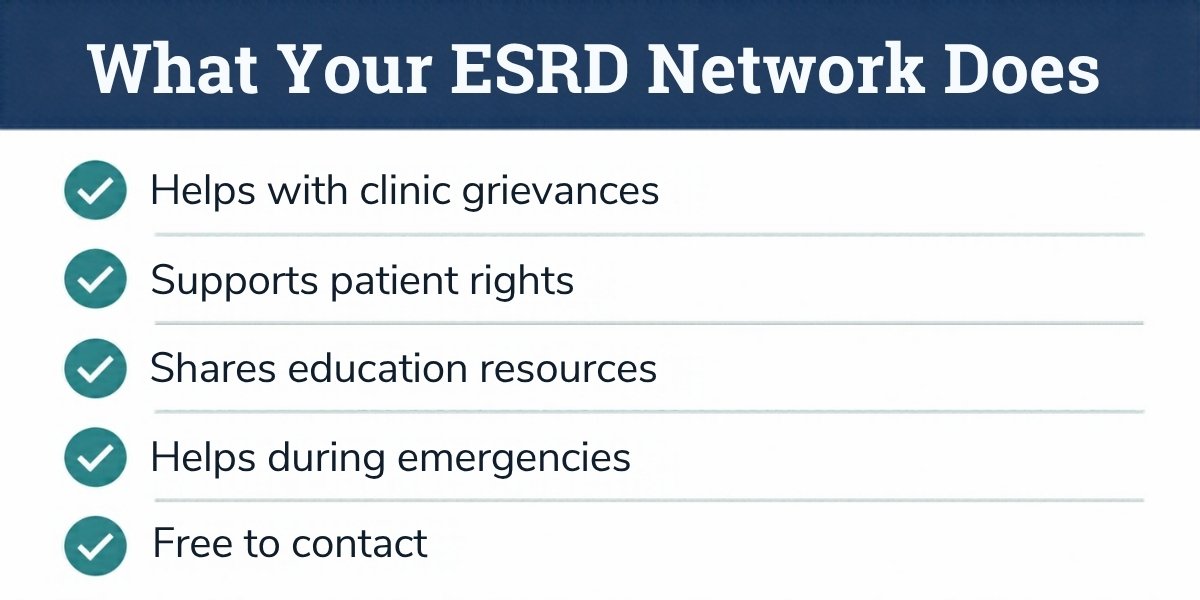
- Investigate grievances. A grievance can be about safety, civility, patient rights, or standards of care.
- Help with access-to-care problems. For example, a patient at risk of involuntary discharge or transfer, or a patient no clinic will accept.
- Work with you and the facility to try to reach a resolution, and advocate based on your rights as a patient.
- Accept confidential or anonymous grievances. Anonymous grievances can still be investigated, but the Network may not be able to report back to you.
- Help during emergencies that disrupt dialysis in the region.
- Offer patient involvement, such as patient advisory committees.
What Networks can’t do
According to one Network’s guide for patients and families, Networks cannot:
- Force a facility to accept a patient
- Close a dialysis facility
- Interfere with state facility inspections
- Hide a patient’s involuntary discharge history
Networks also don’t make medical decisions about your treatment. For a complaint about quality or safety that needs inspection, your state survey agency is a separate option.
When to call your Network
- You raised a concern at the clinic and it wasn’t resolved
- You don’t feel comfortable raising the concern at the clinic
- You’ve been warned you might be discharged, or you received a discharge notice
- You can’t find a clinic that will accept you
- Your clinic closed or can’t treat you during an emergency
- You believe your patient rights aren’t being respected
For most everyday issues, start at the clinic. See How to Raise a Problem at Your Dialysis Clinic.
If this sounds familiar
You complained twice about your treatments starting late and being cut short, and nothing changed. The administrator stopped returning your calls. This is exactly when the Network is useful. Bring your notes with dates and times, and ask to file a grievance.
Finding your Network
- Look at the posted patient rights in your clinic. Federal rules require clinics to prominently post patients’ rights, including the current ESRD Network and state agency mailing addresses and complaint phone numbers.
- Ask your social worker.
- In California, Northern and Southern California are served by different Networks, so check which one covers your clinic.
Save the number in your phone now, before you need it.
What happens when you call
A member of the Network’s patient services team will listen to your concern and may ask for details like the facility name and what happened. Depending on the issue, they may request records from the facility, work with staff on a resolution, and let you know the outcome. Having your notes ready makes the call faster.
Questions to ask the Network
- Can I file this confidentially?
- What will you do next, and when will I hear back?
- Do you need any documents from me?
- Should I also contact the state survey agency?
Save the number with your other contacts
Add your ESRD Network and state agency numbers to your contact sheet so they’re there when you need them.
Where to go next
- Keep it all in one place: The 90-Day Dialysis Planner
- Raising a concern: How to Raise a Problem at Your Dialysis Clinic
- Discharge worries: Can a Dialysis Clinic Discharge You?
- Emergencies: Dialysis Emergency Plan
The main thing to remember
Your ESRD Network is an outside resource whose job includes helping patients when clinics don’t resolve problems. Find its number on your clinic’s posted patient rights, save it, and call when a concern isn’t getting fixed or you’re facing discharge.
Sources
- 42 CFR 494.70: Patients’ Rights
- IPRO ESRD Network: Grievance Process Guide for Patients and Families
- IPRO ESRD Network: Grievances
- Quality Insights Renal Network 4: Access to Care
- American Association of Kidney Patients: You and Your ESRD Network
General education only. This guide offers general information about ESRD Networks as of October 2026. Network roles and contact details can change. Renal Care Planner is not affiliated with any ESRD Network or CMS and does not provide legal advice.