

You spend a lot of hours at your dialysis clinic, with the same staff and the same neighbors. So when something goes wrong, such as long waits, a rough cannulation that keeps happening, a rude comment, or a safety concern, it can feel risky to speak up. Many patients worry about being labeled “difficult.” But you have a right to raise concerns, and there is a clear path for doing it. Starting calm and specific usually gets the best results.
Quick answer
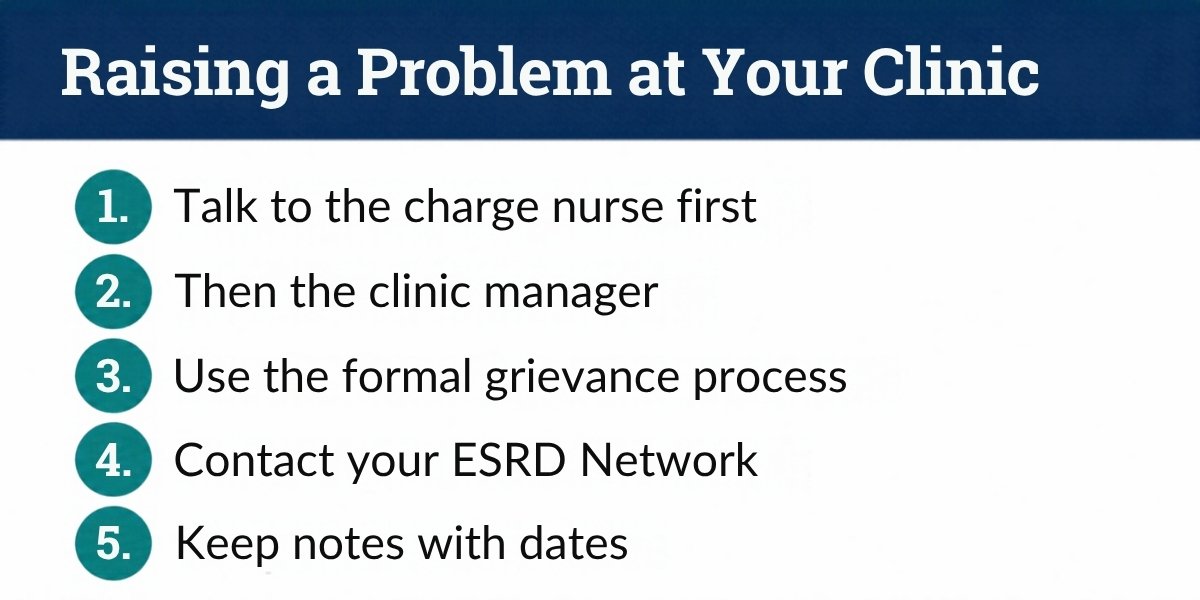
Start with the person closest to the problem, often the charge nurse or nurse manager. If that doesn’t fix it, use the clinic’s formal grievance process and ask to speak with the facility administrator. If you’re still not satisfied, or you don’t feel comfortable going through the clinic, you can contact your regional ESRD Network, which can investigate grievances and help resolve them. You can also file a complaint with your state’s survey agency. Dialysis clinics are required to post patients’ rights and contact information for the Network and state agency.
Safety first
If something is happening right now that affects your safety during treatment, such as bleeding, a needle problem, feeling very unwell, or an alarm no one is responding to, tell staff immediately and clearly. Don’t wait for a formal process. Grievances are for problems that need fixing over time.
Write it down
Before you raise a concern, jot down:
- The date and time
- What happened, in plain facts
- Who was involved (names or roles)
- How it affected you or your treatment
- What you’d like to happen next
Specific notes are much more effective than general complaints, and they help if you need to escalate later.
The escalation ladder
- The staff member or charge nurse. Many problems, like a chair assignment or a repeated miscommunication, are fixed here.
- The nurse manager or clinical manager. For problems that keep happening or involve care.
- The facility administrator and the clinic’s formal grievance process. Ask for the grievance form or policy. Clinics are required to have one.
- Your ESRD Network. If the clinic doesn’t resolve it, or you aren’t comfortable going to the clinic.
- Your state survey agency. A separate option for complaints about quality or safety. In California, that’s the California Department of Public Health’s Licensing and Certification program.
Your dialysis social worker can help at any step, and the medical director or your nephrologist may be the right person for concerns about treatment decisions.
What to say
“I want to raise something that’s happened a few times. On the 3rd, 8th, and 10th, my treatment started more than an hour late, and I ended up getting a shortened run. I’d like to understand why and what can be done. Who should I talk to about this?”
Notice what it does: it’s specific, it describes the impact, and it asks for a solution instead of blaming a person.
Going to the ESRD Network
ESRD Networks are organizations that work under contract with the Centers for Medicare & Medicaid Services (CMS) to oversee dialysis care in each region. They:
- Investigate grievances from patients, families, and others
- Work with you and the clinic to reach a resolution
- Let you file confidentially or anonymously, though an anonymous grievance may limit what they can report back to you
An ESRD Network’s own guide notes that Networks cannot force a facility to accept a patient or close a facility. Their power is in investigating, mediating, and holding facilities to federal requirements. For more, see What Is an ESRD Network?
Your Network’s patient phone number should be posted in your clinic. If you can’t find it, ask the social worker.
The state survey agency
Each state has an agency that inspects dialysis facilities for Medicare. You can file a complaint with it separately from, or in addition to, the Network. In California, contact the local district office of the California Department of Public Health’s Licensing and Certification program.
If this sounds familiar
One staff member has been short with you for weeks, and you’ve started dreading treatment. You’ve kept quiet because you’re afraid of making it worse. Start with a calm conversation with the nurse manager, with your notes in hand. If nothing changes, you have the clinic grievance process and the Network. You don’t have to just put up with it.
Worried about backlash?
Federal rules for dialysis facilities say patients have the right to be informed about the clinic’s grievance process and to file grievances without reprisal or denial of services. If you are worried, you can go straight to the Network and ask to file confidentially. A few tips:
- Stay calm and factual, even when you’re frustrated
- Bring a family member or advocate if it helps
- Keep copies of anything you submit and any responses
- If you notice changes in how you’re treated after raising a concern, write them down and tell the Network
Questions to ask
- Who is the right person to talk to about this?
- Can I see the clinic’s grievance policy or form?
- When should I expect a response?
- What is the ESRD Network’s patient phone number for this clinic?
Keep a simple record
A treatment log with dates, start times, and anything unusual gives you facts to point to if you need to raise a concern.
My Dialysis Care Team & Contacts →
Keep a record of what happened and what you asked. The 90-Day Dialysis Planner keeps treatment notes, patterns, and questions together for three months.
Where to go next
- Understanding Networks: What Is an ESRD Network?
- Threatened with discharge: Can a Dialysis Clinic Discharge You?
- Getting support: What Does a Dialysis Social Worker Do?
- Questions for your team: Questions to Ask Your Dialysis Care Team
The main thing to remember
Speaking up is your right, and it often makes care better for everyone in the clinic. Start close to the problem, be specific, keep notes, and move up the ladder only as needed. If the clinic doesn’t resolve it, the ESRD Network and the state survey agency are there for exactly that reason.
Sources
- 42 CFR 494.70: Condition for Coverage, Patients’ Rights
- Comagine Health ESRD Network: Grievances Guide for Patients and Families
- IPRO ESRD Network: Grievance Process Guide for Patients and Families
- IPRO ESRD Network: Grievances
- Forum of ESRD Networks: Patient Grievance Toolkit
General education only. This guide offers general information about raising concerns at a dialysis facility in the United States as of October 2026. Processes vary by clinic and region. Renal Care Planner does not provide legal advice. For urgent medical problems, tell staff immediately or call 911.