

A boss who won’t flex around your chair time is one of the biggest barriers to working on dialysis. That’s why many people turn to freelancing, gig work, or their own business. You control your schedule, which is a huge plus. But you also take on uneven income, your own insurance, and no sick pay. Here’s how to make it work.
Quick answer
Self-employment can fit dialysis well if you plan around your treatment days and energy. Lock in health coverage first. Medicare based on kidney failure doesn’t depend on a job. Keep an emergency fund for slow months and hospital stays. If you get SSDI, Social Security looks at both your earnings and your hours, so talk to a benefits counselor before you start. Choose work that fits your energy, and avoid heavy lifting on your access arm.
Why it can fit
- You set your hours around treatment days
- You can work during treatment if you’re up to it: emails, writing, planning
- You can rest on rough days without asking permission
- You can scale up or down as your health changes
The tradeoffs
- Income goes up and down
- No paid sick days or disability insurance unless you buy it
- No employer health insurance
- Quarterly estimated taxes and self-employment tax
- No FMLA protection, since you are the employer
Health coverage
Most people on dialysis qualify for Medicare based on kidney failure, regardless of age or job, if they have enough work credits (or a spouse or parent does). It covers dialysis and doesn’t end because you’re self-employed. Many also have a Medigap or Medi-Cal for secondary coverage. If you’re not on Medicare yet, look at Covered California plans. See The Hidden Costs of Dialysis.
SSDI and self-employment
For self-employed people on SSDI, Social Security doesn’t just look at money. A month can count as a Trial Work Period month if you earn above that year’s limit (net earnings) or work more than 80 hours in your business. Social Security may also look at the value of your work. Keep good records of hours and income, and talk to a free benefits counselor before you scale up. See Going Back to Work on Dialysis.

If this sounds familiar
You started doing food delivery on your off days and it’s going well, but you haven’t reported it to Social Security because the money seems small. Report it now. Gig income counts, and hours matter for self-employment. Catching it early can prevent an overpayment later.
Work that fits dialysis
- Often a good fit: bookkeeping, writing, design, tutoring, virtual assistance, customer support, consulting, online sales, phone-based work
- Use caution: delivery and rideshare (driving after treatment, long days, bathroom access), heavy lifting, and jobs that strain your access arm
- Build your hardest work into your best-energy days
More on physical jobs: Physical Jobs and Shift Work on Dialysis.
Managing uneven income
- Build an emergency fund for slow months and unexpected hospital stays
- Set aside a percentage of every payment for taxes
- Tell key clients you may occasionally need to shift deadlines, without oversharing
- Look into private disability insurance, though pre-existing condition rules may apply
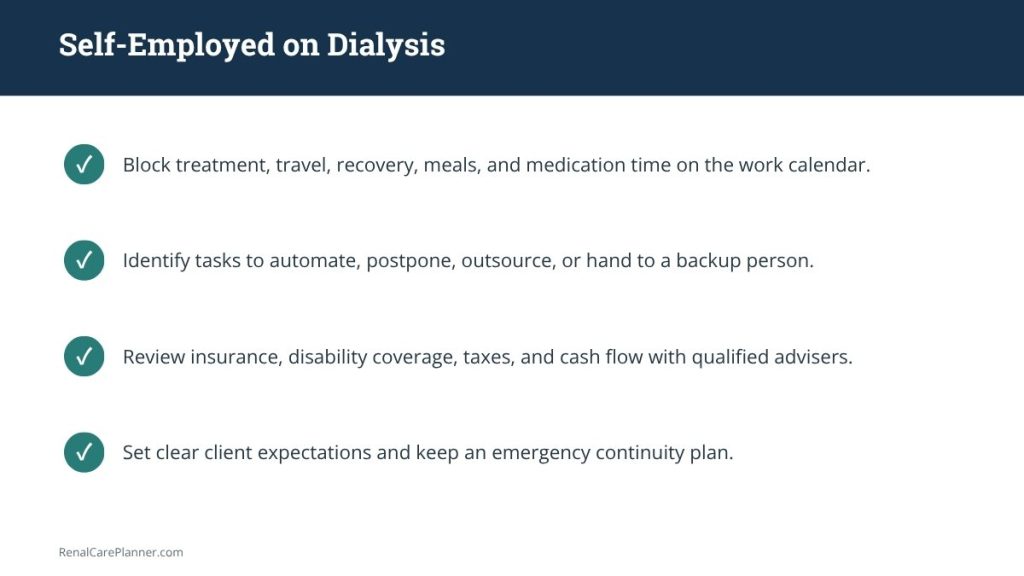
Plan your work week around treatment
Ask your care team about shifts or home options that free up more work time.
Where to go next
- Keep it all in one place: The 90-Day Dialysis Planner
- Working on dialysis: Working While on Dialysis
- Home dialysis: Thinking About Home Dialysis?
- Evening shifts: Evening and Nocturnal Dialysis Shifts
The main thing to remember
Self-employment can give you the flexibility dialysis demands. Secure your health coverage, report income and hours if you’re on SSDI, save for slow months, and choose work that fits your energy and protects your access.
Sources
- SSA Red Book: Trial Work Period
- Medicare.gov: End-Stage Renal Disease
- IRS: Self-Employed Individuals Tax Center
General education only. This article offers general information, not legal, tax, or benefits advice. Talk with Social Security, a benefits counselor, or a tax professional about your situation.