

If in-center dialysis is clashing with your job, school, kids, or energy, home dialysis may be worth a look. Many people who switch say they feel better and have more control over their schedule. It’s not right for everyone, and it takes training and space at home. Here’s how the options compare and what to ask before deciding.
Quick answer
There are two main home options: peritoneal dialysis (PD), done daily through a catheter in the belly, often overnight with a machine, and home hemodialysis (HHD), usually done more often in shorter or overnight sessions. Both need training, usually a few weeks, plus storage space for supplies. Some programs require a care partner, especially for HHD. Ask your nephrologist if you’re a candidate and whether your clinic has a home program, or can refer you to one.
The two home options
- Peritoneal dialysis (PD). Uses the lining of your belly as a filter. Fluid goes in and out through a catheter. Done every day, either with manual exchanges during the day or with a machine (cycler) overnight. No needles.
- Home hemodialysis (HHD). The same basic treatment as in-center, using your fistula, graft, or catheter, but at home. Often done five or six days a week in shorter sessions, or overnight while you sleep.
Benefits and tradeoffs
What many people like: no commute to the clinic, a schedule built around work or school, often fewer diet and fluid limits with more frequent treatment, and less of the “washed out” feeling after long in-center sessions.
What to weigh: you’re responsible for treatments, setup, and cleanup; supplies take up space; PD carries a risk of peritonitis if technique slips; HHD often involves putting in your own needles; and some people miss the social side of the clinic or worry about burnout.
Do you need a care partner?
It depends on the program and the type. Many people do PD on their own. HHD programs often require a trained partner, though some allow solo treatment with safety measures. If a family member would be your partner, talk honestly about what that commitment means for them. See When Your Partner Starts Dialysis.
What your home needs
- Storage space for monthly supply deliveries (boxes of fluid can take up a closet or more)
- A clean, private area for treatment
- Reliable electricity, and for some HHD systems, plumbing changes
- A plan for power or water outages. See Dialysis Emergency Plan.

If this sounds familiar
Your in-center chair time keeps conflicting with your shift, and you’re running out of sick days. Ask your nephrologist at your next visit: “Am I a candidate for PD or home hemo, and how soon could I start training?” Overnight PD, for example, can free up your entire workday.
Questions to ask your team
- Am I a medical candidate for PD, home hemo, or both?
- Does this clinic have a home program, or where would I train?
- How long is training, and what’s the schedule?
- Do I need a care partner? What would they need to learn?
- What access or surgery would I need?
- How much storage space will supplies take?
- Who do I call at 2 a.m. if something goes wrong?
- How does insurance cover home dialysis and supplies?
- Can I switch back to in-center if it doesn’t work for me?
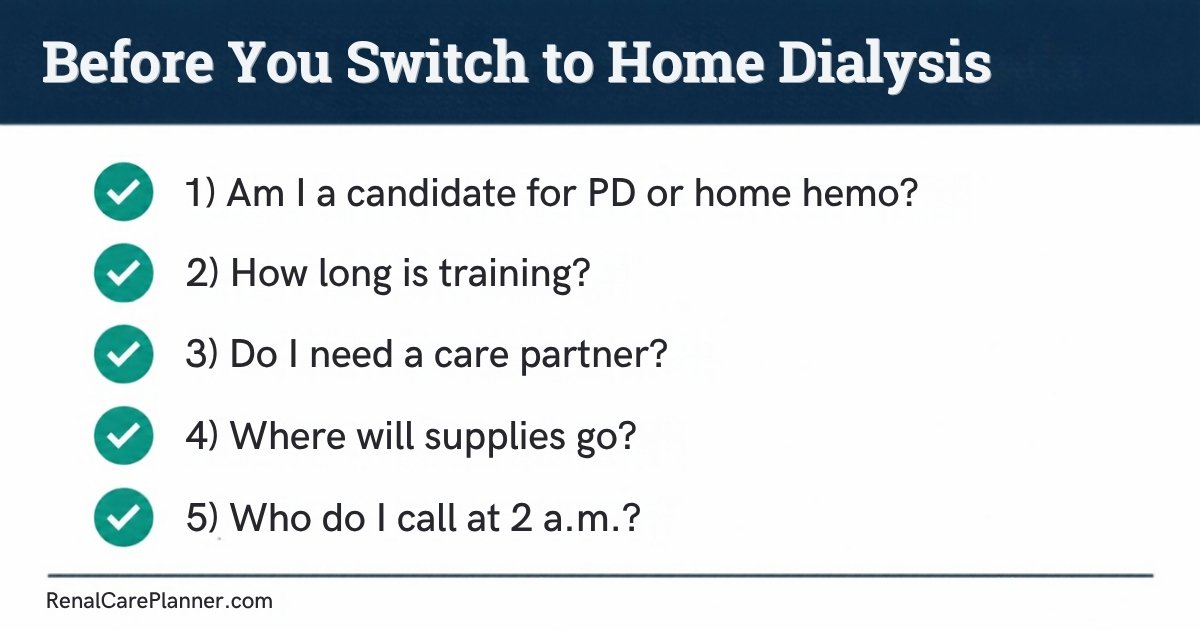
Take these questions to your next visit
Add them to your question list so you leave with real answers.
Where to go next
- Keep it all in one place: The 90-Day Dialysis Planner
- Work: Working While on Dialysis
- Evening and overnight in-center: Evening and Nocturnal Dialysis Shifts
- Schedule changes: How to Change Your Dialysis Chair Time
The main thing to remember
Home dialysis can give you back flexibility and energy, but it’s a real commitment. Ask whether you’re a candidate, understand the training, space, and partner needs, and know you can usually switch back if it doesn’t fit.
Sources
- NIDDK: Peritoneal Dialysis
- NIDDK: Hemodialysis (including home hemodialysis)
- National Kidney Foundation: Home Hemodialysis
General education only. This article offers general information and is not medical advice. Whether home dialysis is right for you depends on your health, home, and support. Talk with your nephrologist and home dialysis team.