

Your first week on hemodialysis can produce more information than anyone is likely to remember clearly: weights, blood pressure checks, machine alarms, new terms, medication instructions, access care, and how you felt afterward. A short record can help you notice what you want to ask about without turning treatment into a spreadsheet.
Quick answer
During your first week, track only what helps you remember what happened: the treatment date, any numbers staff gave you, how you felt before and during treatment, staff actions you want explained, anything different about your access, how long recovery took, new instructions, and one question for next time. Do not use your notes to change your own dry weight, UF goal, medicines, fluid limit, or treatment time.
Before your first treatment: know what to bring and what to expect
A few basics are worth knowing before you sit down for your first treatment. If the process itself still feels unfamiliar, start with Your First Hemodialysis Treatment: What to Expect. Your access will be an AV fistula, AV graft, or central venous catheter, and each is handled differently — see Fistula vs. Graft vs. Catheter if you are still learning which one you have.
Pack the same bag every time so treatment day takes less thinking: ID and insurance card, your medication list, phone and charger, something to do, a layer of clothing if you get cold, a snack or drink if your dialysis center allows it, reading glasses if you use them, and anything staff specifically asked you to bring. For more on this, see What to Bring to Dialysis.
Your first treatment: start with a simple record
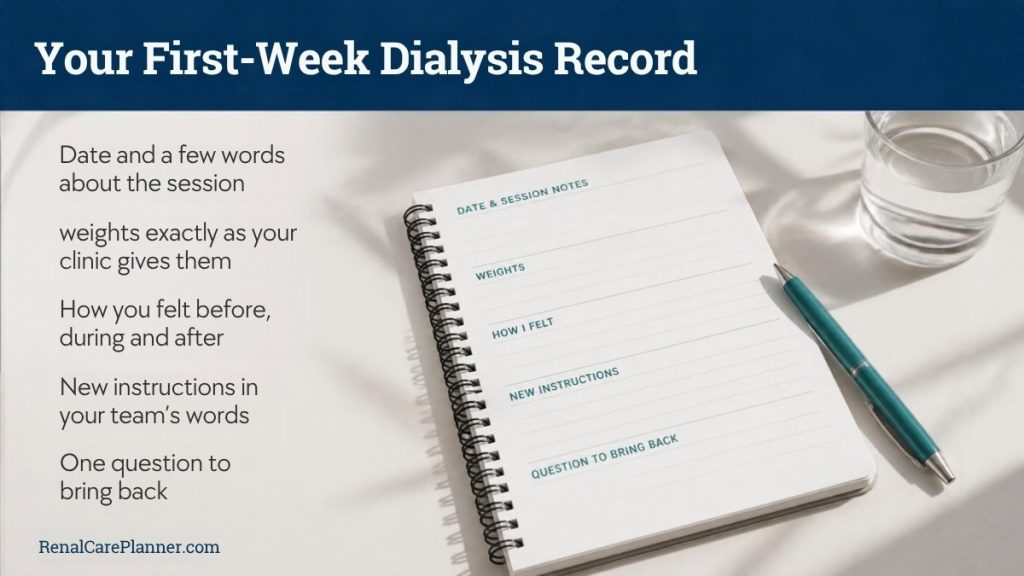
Write down the date and, if it helps you, roughly when treatment started and ended. Then note the session in a few words: routine, something stood out, shortened or stopped early, or missed. A routine day does not need a long explanation — if nothing stood out, that itself is worth writing down and moving on.
Your prescribed treatment time comes from your dialysis care team, and a session running shorter or longer on one day does not tell you by itself whether the treatment was adequate. If you are wondering why treatments take several hours in the first place, see Why Does Dialysis Take So Long? If a treatment was shortened or missed, write down what happened and any instructions you were given, and contact your center as soon as possible — writing it down does not replace that call.
Numbers you’ll hear for the first time
If your clinic gives you your pre- and post-treatment weights, you can record them exactly as provided, along with how much fluid was taken off. These numbers help your care team plan and review fluid management — they should not be used on their own to calculate what your removal goal should have been. For the difference between scale weight, target weight, and fluid removal, see Why Are You Weighed Before and After Dialysis? and What Is Dry Weight in Dialysis?
You may also hear a term such as UF goal, target weight, blood pressure, or a lab value mentioned directly to you. If a number stood out because staff discussed it with you, write down the number along with the term they used. Writing “Staff said my blood pressure was low during treatment” preserves what you were told without trying to diagnose why.
How you felt before and during treatment
A short note about how you felt before the session gives useful context later: about the same as usual, unusually tired, short of breath, nauseated, swollen, crampy, dizzy, or something else. Do not wait until after treatment to mention something important — tell the dialysis team while you are there so they can check it in real time.
If something happened during treatment, record the symptom in plain language: cramps, dizziness, nausea, headache, feeling unusually cold, weakness, itching, chest discomfort, or shortness of breath. You do not need to attach a cause — the same symptom can have more than one explanation. Note what you felt and, if you remember, what staff checked or did afterward. Related guides: Why Do I Get Cramps During Dialysis? and Why Blood Pressure Can Drop During Dialysis.
Staff actions and new instructions worth writing down
You may notice staff laying your chair back, rechecking your blood pressure, repositioning a needle, reducing fluid removal, using saline, or pausing treatment. Recording that an action happened gives you a useful question for next time — but keep the fact separate from the reason unless staff told you the reason directly. “I cramped and saline was used” is a fact; “they gave saline because too much fluid was removed” is an interpretation your notes can’t establish.
Write down new instructions in the words your team used, especially about medicines, food, fluid, access care, or who to call with a problem. If an instruction is unclear, mark it as a question rather than filling in the gap yourself — medication timing around dialysis is a common example where this matters. See Medication Timing and Dialysis.
Protect your access from day one
Your access deserves its own line in your notes from the first treatment on. If you have a fistula or graft, notice whether the area looks different from usual, whether it’s more tender than usual, or whether the vibration you normally feel seems different. If you have a catheter, follow your clinic’s dressing instructions. Tell your care team if the dressing becomes wet, loose, or dirty, or if you notice redness, swelling, or drainage around the catheter site.
NIDDK advises people with a fistula or graft to check for the usual vibration over the access and tell the dialysis center if it is absent. CDC encourages reporting redness, swelling, drainage, or other possible signs of infection. See How to Protect Your Fistula or Graft, or for catheter care, Can You Shower With a Dialysis Catheter?
After treatment: recovery in your first week
Recovery varies from person to person and treatment to treatment, especially in the first week. A simple note is enough: right away, within a few hours, later that day, the next day, or not yet. “Needed a two-hour nap” or “dizzy when standing” tells you more later than trying to score every symptom. If fatigue keeps showing up, see Why Am I So Tired After Dialysis?

Between treatments: choose one question to bring back
End each treatment note with one or two questions you actually want answered. Keeping the list short makes it more likely you’ll actually ask:
- Can we review what happened with my blood pressure during this treatment?
- What were you checking when my needle was repositioned?
- Can you explain the goal you used for fluid removal today?
- Is there anything different you want me to watch for with my access?
For more options, see Questions to Ask Your Dialysis Care Team. To record each session, use the Daily Treatment Tracker, and to see patterns over time, use the 90-Day Dialysis Planner.
What you do not need to track
You do not need to recreate the clinic’s treatment record. Staff already document machine settings, medications given, vital signs, access assessments, and clinical interventions as part of your treatment record.
- You do not need to calculate your own dry weight.
- You do not need to decide your own fluid-removal goal or rate.
- You do not need to classify every blood pressure reading as good or bad — simply record the number and what staff told you about it.
- You do not need to diagnose the cause of a symptom or machine alarm.
- You do not need to record every routine action staff perform.
Make your first week easier to organize
Renal Care Planner’s free planning tools can help you keep your first-week notes and questions together without building your own tracker from scratch.
The main thing to remember
A useful first-week record is short and factual. Write down what happened, how you felt, what you were told, and what you want to ask. Leave diagnosis and treatment decisions to the care team that has the full clinical picture.
Sources
- National Institute of Diabetes and Digestive and Kidney Diseases: Hemodialysis
- National Kidney Foundation: Hemodialysis — How It Works, Types, and What to Expect
- Centers for Disease Control and Prevention: Infections and Patients on Dialysis
General education only. This article helps patients organize information they remember from dialysis. It does not interpret treatment data, diagnose symptoms, assess urgency, or recommend changes to dialysis, medicines, food, or fluid. Contact your dialysis care team with questions about your own treatment.